EFFIGIES and MARKERS

Sunday, June 14, 2009

Llanthony times two

Llanthony Priory kept coming up in my research as a burial place for my ancestors the de Bohuns. On a map, I found a Llanthony in Monmouthshire, Wales, but the historical references were usually to “Llanthony in Gloucester.” How could that be? So I launched an internet investigation, wrote some emails, and visited both sites (for there are two indeed) on a 2006 vacation in UK.


Llanthony Prima, Wales
I made a point of visiting Llanthony Prima Priory near Abergavenny, six miles northwest of Llanfihangel Crucorney, Gwent, mid-Wales. What a beautiful site.


Llanthony Priory was founded in the Vale of Ewyas, in the Black Mountains of Wales, as a chapel dedicated to St. David, but became a priory in 1118. Hugh de Lacy (brother or cousin of my de Lacy ancestors) assumed its patronage and endowed it with lands. In about 1135, the rebellious Welsh, who had been displaced by the conquering Normans (including my ancestor Miles fitzWalter of Gloucester), sacked the priory. After a restoration of peace, the de Lacy family renewed their financial support and imported personnel from Gloucester to re-establish the priory.


However, repeated Welsh attacks on the remote and unprotected Llanthony made it dangerous. In 1136, the monks who had retreated from Wales established a daughter priory in Gloucester, called Llanthony Secunda.


Building the Llanthony Prima church began about 1180, and continued for 50 years. It began at the east end (the chancel) with rounded arches, and continued toward the west, with more gothic architectural features as the years passed.


To get to Llanthony Prima, you really have to want it, and intend to find it. But I found my way easily. The four-mile drive is mostly one vehicle wide, with occasional wide spots for courtesy passing, as in: one car stops and waits for the oncoming car to squeak by. There are places of dark, dense woods, and places where you drive between 8-foot hedgerows, and other spots you can see across the sheep-dotted river valley to the tree-covered escarpment. The late-afternoon sun was sometimes behind the mountains and sometimes spotlighted impossibly green pastures with grazing horses.

Admission to Llanthony is free, and there were a fair number of people there, who had been staying in the inn there and taking horse treks up into the mountains. Sounds like a very nice vacation! The horses have big, furry hooves, like draft horses, but they weren’t that tall. They were Welsh Cobs, descendants of war horses that could carry medieval warriors in heavy armor, and were good swimmers and jumpers. I suppose the wider hoof makes them more sure-footed.


Llanthony Prima--
where the altar would have been
The priory was very pretty, and you could see that it must have been a lovely gothic place when it flourished. The stones of the windows and crossing still stand. There’s also a wall that hangs 15 degrees off of plumb. The priory was sacked several times, by Welshmen, and by Henry VIII’s Dissolution vandals, who really gave it the death sentence.

Llanthony Secunda, Gloucester
My ancestors’ connection with “Llanthony” continued in the 12th century with Sybil de Neufmarche, daughter of Bernard de Neufmarche, Lord of Brecon (a conquering Norman) and Nest, granddaughter of the ruler of Wales, Gruffydd ap Llywelyn. Sybil de Neufmarche married Miles fitzWalter in 1121. Miles fitzWalter, 1st Earl of Hereford, Lord of Brecknock, and sheriff of Gloucestershire, lived 1100-1143. Sybil and Miles had seven children, two of whom were my ancestors: Bertha of Hereford, who married William de Braose; and Margaret de Gloucester, who married Humphrey (III) de Bohun.

Llanthony Prima and Secunda were Augustinian houses administered by the same prior from 1136 until 1205, when they formally separated. The Gloucester priory, established near the Southgate suburbs of the walled city, was richly endowed by Miles of Gloucester (Earl of Hereford). The lands had already been granted to the church by Miles’ father, Walter of Gloucester, and his father before him. Now they were attached to the new Llanthony Priory.

The Abbey of St. Peter, which became Gloucester Cathedral, considered that Llanthony Secunda “poached” grants of lands and monies (and lucrative burials and obituary masses) from local noble families. There was a decades-long argument over where Miles of Gloucester should finally be buried. Llanthony won. (But Gloucester Cathedral still stands!)

Llanthony Priory Secunda is the location where about 10 generations of de Bohuns (pronounced “Boon”) and others were buried. There’s not much left of the property but a few tithe barns and outbuildings.


I visited Llanthony Secunda on a windy and chilly morning in September. It’s just a block or two off the Bristol Road, near the historic docks on the Severn River, and near Gloucester’s city center. The entrance to the historic site is located in an industrial area. There’s a stone arched gateway into the grounds that remains from the 12th century.  This is a Google Maps view of Llanthony Secunda.


View Larger Map

Based on the storyboard plaque, I took photos of the site where the church had been, and even have a shot of the college building under construction, in the background of the ruins. I’m glad that the site is being preserved the best it can be after its abuse in previous centuries. The loss of the tomb effigies is horrible.
Gatehouse of Llanthony Secunda
The priory and its church, where all those de Bohuns were buried, was obliterated at Henry VIII’s Dissolution, and took heavy damage when it was a besiegers’ fort in 1643 during the Civil War. In 1810 or so, when a canal and rail line were built through there, they found human remains about two meters deep, which they then burned. The site is now protected as a historical monument.

My ancestors known to be buried at Llanthony Secunda in Gloucester include:
...Miles fitzWalter of Gloucester, 1100-1143
...Sybil de Neufmarche (his wife), d. 1143
...Humphrey III de Bohun, 1109-1187
...Margaret of Gloucester (m. Humphrey III de Bohun), 1125-1187
...Henry de Bohun, 1176-1220
...Humphrey V de Bohun, 1208-1275
...Maud d’Eu (his wife), 1208-1241
...Eleanor de Braose (m. Humphrey VI de Bohun) d. 1251

Additional links:
Gloucester.gov
England and Normandy in the Middle Ages 
The Trials of Llanthony [Prima] 


Christy K Robinson is the author of five-star nonfiction and fiction historical books, as well as author of Discovering Love, Rooting for Ancestors and William and Mary Barrett Dyer websites. You will find her books at http://bit.ly/RobinsonAuthor.


·          We Shall Be Changed (2010)
·          Mary Dyer Illuminated (2013)
·          Mary Dyer: For Such a Time as This (2014)
·          The Dyers of London, Boston, & Newport (2014)
·          Effigy Hunter (2015)
·          Anne Marbury Hutchinson: American Founding Mother (2018)

Wednesday, February 18, 2009

St Mary's Staindrop, home church of Nevilles

St. Mary's Staindrop, west end
Twelve hundred year-old St. Mary’s church, in the village of Staindrop near Raby Castle in County Durham, seems an unlikely place to hold the tombs of the powerful Neville family. It’s just a few miles down the road from the beautiful Raby Castle, built by my ancestors the Nevilles, and now a palace for Lord Barnard and his family.

Many aristocratic families buried their dead in abbeys, priories, and large, impressive churches--and those edifices were destroyed at the Dissolution by Henry VIII, or in the English Civil Wars in the mid-17th century. But Staindrop St. Mary's has survived intact, perhaps because it was small and out of the way.  "The first shall be last, and the last shall be first."


In fact, St. Mary’s at Staindrop was a very important abbey church from Saxon times. My ancestors through Robert Fitzmaldred, a Saxon lord who married Isabel de Neville, go back to Saxon and Scottish royalty. Isabel’s de Neville’s ancestors go back to Neuville-sur-Touques, Normandy, about 1000 AD. The church predates both Robert and Isabel by 300 years.

Staindrop church in present-day shape.
The nave was square in the 11th century, rectangular in the 12th,
and in 1343, Ralph Neville (who is buried in Durham Cathedral!)
enlarged it to a square again by adding the Lady Chapel
on the south for the Neville women's burials.

The marriage of Robert Fitzmaldred (1172-1242) and Isabel de Neville (1176-1254) brought the Norman Neville name, estates, and influence together with the Saxon landholders of Raby, in a family that would strongly influence English history for hundreds of years – and 800 years and 27 generations later, result in the author of this blog.

Two couples of Nevilles are entombed at Durham Cathedral: Lady Maud de Percy (1335-1378) and husband Lord John Neville (1328-1388); and Lord Ralph Neville (1291-1367) and his wife Lady Alice d’Audley (d. 1374). They were patrons of Durham Cathedral and donated the magnificent carved-stone Neville Screen in the chancel of the cathedral. Several generations of Nevilles were buried at Coverham Abbey near Middleham Castle, which the Nevilles inherited.

Those with medieval effigies in the Staindrop church:

…Margery de Thweng Neville, 1st wife of Baron Ralph Neville (1291-1367, who is buried at Durham cathedral with 2nd wife Alice d’Audley). Margery died childless.

Center aisle and chancel of St. Mary's, Staindrop

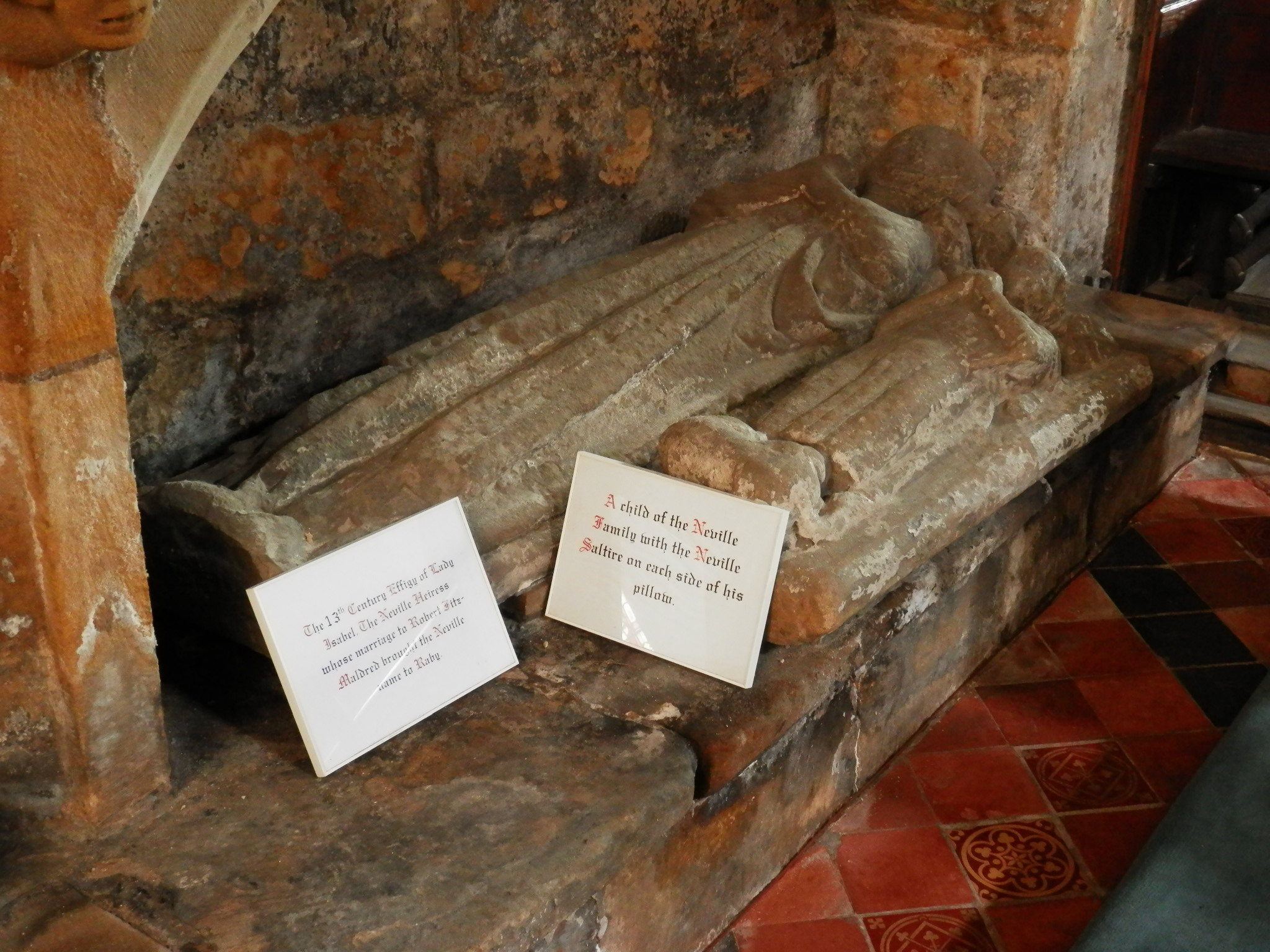
…Isabel de Neville, 1176-1254. Her husband Robert Fitzmaldred’s burial place is unknown.   

Isabella deNeville and unidentified 
child of a deNeville family. 
The sign on the left says "The 13th Century effigy of Lady Isabel,
the Neville heiress whose marriage to 
Robert FitzMaldred brought the Neville name to Raby."
The sign on the right says "A child of the Neville
family with the Neville saltire on each side of the pillow."
Image from Find-a-Grave.


…Child’s effigy, unknown name. Perhaps this effigy represents one child, or many infants or children who succumbed to stillbirth, illness, or injury, who are buried in the church.

…Euphemia de Clavering Neville, 1267-1339. Her husband Randolph Neville was buried at Coverham Abbey in Yorkshire, on the south side of the altar of the abbey church (destroyed in Henry VIII's dissolution). For a lovely description with excellent photos of Euphemia's effigy, visit http://anhrefn.blogspot.com/2011/06/euphemia-de-clavering.html   

Effigy of Euphemia deClavering, mother of Ralph Neville II

…Ralph Neville, 1st Earl Westmorland, 1364-1425. (Ralph’s effigy and tomb is here, plus both wives’ effigies: Margaret Stafford was buried at Brancepeth Castle and Joan Beaufort was buried at Lincoln Cathedral). This Ralph, in 1408, was granted the license to found a college at the church, with an endowment the equivalent of today’s £300,000. For my article on this Ralph, see:  http://rootingforancestors.blogspot.com/2009/02/ralph-neville-1st-earl-westmorland-1364.html 

The font is Egglesone marble 
from late 15th century, 
and carries the arms of 
Edward Neville, 1st Lord Bergavenny 
(d. 1476), son of Ralph Neville, 
1st Earl Westmorland.

The Staindrop roof has been raised, and you can see a steep pitch in the stonework above the chancel, below the nearly-flat beamed ceiling. The red-ochre and black floor tiles are medieval, and similar colors and style may be seen at many medieval churches across England, including Lincoln, Gloucester, Winchester, Tutbury, and Merevale. The original Saxon church was a cruciform plan, but was enlarged in the 1200s and 1300s by the Nevilles’ sponsorship, and is now nearly a square because the aisles were enlarged by creating space to the west of each transept. The aisles and west end of the nave hold the memorials to the Lords of Raby over the centuries. 

Anchorite (hermit) window

The ceiling of the choir is decorated with the Neville arms, and off to the left of the choir is a small viewing window high up, which is a hermit’s view of the altar and Eucharistic ceremonies, according to the signage there. The description of “anchorite” http://en.wikipedia.org/wiki/Anchorite seems to fit the Staindrop cell better than that of “hermit,” and I found a reference to an anchoritic cell at Staindrop: “… a chamber with an ancient fire-place over the vestry of this church. At the head of the stone newel staircase is a square-headed window of three lights, the mullions of which are cut askew from east to west in order to command the high altar.” http://www.historyfish.org/anchorites/clay_anchorites_seven.html

"The [Staindrop] Church, dedicated to the Blessed Virgin, is a most interesting structure, and bears traces of great antiquity, many distinct evidences of a church of early Saxon foundation being still in existence. The church, in its present form, consists of nave, north and south aisles, both of which are wider than the nave itself, chancel, with spacious vestry, and priest's house or "domus inclusa" [anchorite cell] over it, a north transept, an engaged western tower, and south porch. Traces of an early Saxon church are to be seen in the spandrils of the three eastern arches of the nave on each side, and in the eastern wall of the nave, as high as the springing of the Early Pointed roof. The material used in these ancient fragments of walls is coarse rubble, thickly patched with original moss, decisive proof that a great part of it has not been quarried, but won from the surface." [From History, Topography and Directory of Durham, Whellan, London, 1894] Source: http://www.joinermarriageindex.com/pjoiner/genuki/DUR/Staindrop/index.html

I confess to rushing through the church tour, so as to get to my objective: photographing the effigies of my ancestors. So in addition to my observations, I owe some of Staindrop’s history (and the floor plan drawing) to a pamphlet I purchased at the back of the church, St. Mary’s Staindrop, An Illustrated History and Guide, by Clifton Sutcliffe, William K. Trotter, and Rev. David R. Jones.

Ralph Neville, first Earl Westmorland,
with one of his wives. 
Photo by Christy K Robinson

Also, a hearty thanks to the pastoral staff of Staindrop for leaving the church unlocked during the day so visitors (on pilgrimage from California!) can enter for worship, for study, for reverie, or paying respects to their dusty ancestors.

************* 
Christy K Robinson is the author of five-star nonfiction and fiction historical books, as well as author of Discovering Love, Rooting for Ancestors and William and Mary Barrett Dyer websites. You will find her books at http://bit.ly/RobinsonAuthor.

·          We Shall Be Changed (2010)
·          Mary Dyer Illuminated (2013)
·          Mary Dyer: For Such a Time as This (2014)
·          The Dyers of London, Boston, & Newport (2014)
·          Effigy Hunter (2015)
·          Anne Marbury Hutchinson: American Founding Mother (2018)

Monday, February 16, 2009

Ralph Neville, 1st earl Westmorland, 1364-1425


© 2009 Christy K Robinson
 

Who was Ralph Neville?

...Grandson of Henry Percy, 1st Earl of Northumberland
...Grandson-in-law of Earl of Warwick
...Son-in-law of Earl of Stafford
...Son-in-law of John of Gaunt, Duke of Lancaster, King of Castile
...Married to granddaughter of King Edward III of England
...Married to cousin of King Richard II of England
...Brother-in-law of King Henry IV of England
...Grandfather of King Edward IV of England
...Grandfather of King Richard III of England
...Grandfather of Henry Lord Scrope of Bolton


This is a short pedigree of Ralph:
Father: Sir John de Neville, 3rd Baron Neville b. c 1330 d. 17 Oct 1388
Paternal grandfather: Ralph de Neville, 2nd Lord Neville b. c 1291 d. 5 Aug 1367
Paternal grandmother: Alice Audley b. c 1304 d. 12 Jan 1373/74
Mother: Maud de Percy b. c 1335 d. 18 Feb 1379
Maternal grandfather: Sir Henry Percy, 2nd Lord Percy b. 6 Feb 1301 d. 26 Feb 1351/52
Maternal grandmother: Idoine de Clifford b. c 1300 d. 24 Aug 1365


Ralph Neville was my ancestor 21 generations ago on at least three lines. That’s not surprising, considering that he sired 23 children by his two wives. There are millions and millions of Neville descendants.

His Neville pedigree is known for 11 previous generations, going back to Neuville-sur-Touques [48-51'-40.92'' N by 0-16'-55.17" E], France, in the early ninth century. Google Earth shows this site as a long ridge surrounded by farmland.

There are several Ralph Nevilles over several hundred years, and because his son Ralph Neville married his step-sister Mary Ferrers (my ancestor on another line), I was confused about who this Ralph was. So here's a timeline of a very important personage in medieval England.

1364: Ralph Neville, 1st earl Westmorland, was born at Castle Raby, Durham, son of Sir John Neville, KG, 3rd Baron Neville, and Maud de Percy. Ralph was the fifth of eight children.
1380: Knighted by Thomas of Woodstock on Brittany expedition.
1382: Ralph and Lady Margaret de Stafford married, both about 18 years of age.

Margaret de Stafford (1364October 18, 1396) was the second daughter of Hugh de Stafford, 2nd Earl of Stafford and Philippa de Beauchamp, daughter of Thomas de Beauchamp, Earl of Warwick, and Katherine de Mortimer. Margaret became the first wife of Ralph de Neville. See article on Margaret's grandfather, Ralph Stafford, 1st Earl Stafford, here.

Margaret was a maternal first cousin of the 1st Earl of Worcester and the 13th Earl of Warwick; as well as a maternal aunt of the soldier and commander William de la Pole, 1st Duke of Suffolk and a paternal aunt of the military commander Humphrey Stafford, 1st Duke of Buckingham.

Lady Margaret, Baroness Raby, had nine children by Ralph de Neville, two of whom are my ancestors:
1. Maud de Neville (d. October
1438), married Piers de Mauley, 5th Baron Mauley
2. Alice Neville, married first Sir Thomas Grey of Heton; married second Sir Gilbert Lancaster
3.
Philippa de Neville, married Thomas de Dacre, 6th Baron Dacre
4.
John de Neville, Lord Neville (d. 1420)
5.
Sir Ralph Neville, married Mary Ferrers, his step-sister, daughter of Sir Robert Ferrers and Joan Beaufort and had issue
6. Elizabeth de Neville, a nun
7. Anne de Neville, married Sir Gilbert
Umfraville
8. Margaret Neville, Baroness Scrope of Bolton, married first
Richard Scrope, 3rd Baron Scrope of Bolton and had issue before he died two years later; married second William Cressoner.
9. Anastasia de Neville

1385: Joint Keeper of the castle and city of Carlisle
1386: Joint warden of west march of Yorkshire with his father.
1388: Ralph, age 24, became the fifth Baron Neville de Raby at the death of his father. Baron Neville de Raby, also referred to as Baron Raby, was an ancient title in the Peerage of England. It was first created around 1295 for his ancestor Ralph Neville, 1262-1331.
1389: Keeper of forests beyond the Trent
1396: Keeper of Wark Castle (Percy territory) until 1425
1396: Wife Margaret de Stafford died Oct. 18, aged 32, after bearing nine children (seven girls, two boys) in 14 years; she was buried in St Brandon’s Church, Brancepeth Castle, Durham.


1397: Feb. 3, Ralph Neville married Joan Beaufort Ferrers, daughter of Katherine Roet Swynford and John of Gaunt (son of King Edward III).

Joan de Beaufort was born about 1375. Joan, although granddaughter of a king, and daughter of the Duke of Lancaster, was illegitimate at the time of her first marriage to Robert de Ferrers, Baron Wemme, descendant of the earls of Derby, her third cousin once removed.
Along with her three brothers, Joan was privately declared legitimate by their cousin King
Richard II of England in 1390, but their father secured another declaration from Parliament in January 1397. Joan was already an adult when she was legitimized by the marriage of her mother and father with papal approval. The Beauforts were later barred from inheriting the throne by a clause inserted into the legitimation act by their half-brother, King Henry IV. Soon after this declaration, on/before 3 February 1397, Joan (widow of Robert Ferrers, my ancestor) married Ralph de Neville, 1st Earl of Westmorland, who had also been married once before. Ralph and Joan married at Chateau de Beaufort, says the genealogical rumor mill, as that was Joan's surname, and a property of her father, John of Gaunt. However, it doesn't seem logical or likely that they'd take that trip in the winter for some romantic notion.

Ralph Neville had fourteen children by Joan Beaufort (who already had two Ferrers daughters):
1.
Lady Katherine Neville, married first on January 12, 1411 John Mowbray, 2nd Duke of Norfolk; married second Sir Thomas Strangways; married third John Beaumont, 1st Viscount Beaumont; married fourth Sir John Woodville (d. August 12, 1469).
2.
Lady Eleanor Neville (1398-1472), married first Richard le Despencer, 4th Baron Burghersh, married second Henry Percy, 2nd Earl of Northumberland
3.
Richard Neville, 5th Earl of Salisbury (1400-1460)
4.
Robert Neville (d. 1457), Bishop of Durham
5.
William Neville, 1st Earl of Kent (d. 1463)
6.
Edward Neville, 1st Lord Bergavenny (d. 1476)
7. Anne Neville (1414-1480), married
Humphrey Stafford, 1st Duke of Buckingham
8.
Cecily Neville (1415-1495) ("Proud Cis"), married Richard, 3rd Duke of York; mother of Kings Edward IV of England and Richard III of England
9.
George Neville, 1st Baron Latymer (d. 1469)
10. John Neville, died young
11. Cuthbert Neville, died young
12. Thomas Neville, died young
13. Henry Neville, died young
14. Joan Neville, a nun


Joan Beaufort, Countess Westmorland, died 13 Nov. 1440 at Howden, Yorkshire; Joan’s effigy is with those of her husband Ralph Neville and his first wife Margaret Stafford at Staindrop church, Raby, Durham, but she is actually buried at Lincoln Cathedral with her mother, Katherine Roet Swynford, third wife of John of Gaunt. The Lincoln Cathedral tombs were vandalized in 1640 during the Civil War, but the tomb boxes remain on the south side of the chancel.

1397: Ralph created 1st Earl of Westmorland. Held castles of Raby, Brancepeth, Middleham, Sheriff Hutton. Given lordship of Richmond for life.
1399-1412: Earl Marshal of England. The Earl Marshal is the eighth of the Great Officers of State, with the Lord High Constable above him and only the Lord High Admiral beneath him.
1402: He was made a Knight of the Garter, taking the place left vacant by the death of Edmund of Langley, 1st Duke of York. Neville was a supporter of King Henry IV of England, his wife’s half-brother.
1403: Helped put down Percy revolt regarding Henry IV’s usurpation of throne. His mother was a Percy, so of course he was closely allied with them.
1403: Became warden of Richard Scrope, 3rd Lord Scrope of Bolton, aged 10, my ancestor. Richard Scrope married Margaret Neville, daughter of Ralph Neville and Margaret Stafford. Richard was killed in battle 1320, leaving two-year-old son Henry Scrope, who also became ward of Ralph Neville, his grandfather.
1403-1414: Warden of Carlisle and the Western March
1405: Parleyed with Archbishop Scrope and Thomas Mowbray to stop hostilities with Henry IV. They were seized and executed.
1405: Negotiated with Scots and kept peace on borders.
1408: Ralph was granted the license to found a college at Castle Raby's Staindrop St Mary's church, with an endowment the equivalent of today’s £300,000.
1415: Ralph decisively defeated an invading Scottish army at the Battle of Yeavering. The Battle of Yeavering (or Battle of Geteryne) was fought on July 22, 1415 between English and Scottish forces near Yeavering in Northumberland. A small English force consisting of 440 men led by Ralph Neville Earl of Westmoreland defeated 4,000 Scots. Fought in the same year as Henry V's Battle of Agincourt which famously established the efficacy of the longbow against cavalry, it is notable that the English side at Yeavering consisted mostly of archers.
1415: member of the Council of Regency, during King Henry V's absence abroad.
1425: Oct. 21 Ralph died at Castle Raby, Durham, aged 61, leaving 23 children. Buried in nearby Staindrop Collegiate Church, with alabaster effigies of himself and two wives, both of whom are buried elsewhere (Margaret at Brancepeth, Durham; and Joan at Lincoln Cathedral with her mother). The alabaster effigies came from a quarry owned by John of Gaunt.

When Ralph de Neville died in 1425, his lands and titles should by law have passed to his eldest surviving son from his first marriage to Margaret Stafford, her son Ralph de Neville (the son). Instead, while the title of Earl of Westmorland and several manors were passed to Ralph the younger, most of the senior Ralph's estate went to his surviving wife, Joan Beaufort*. The result was years of conflict between Joan and her nine step-children, who fiercely contested her acquisition of their father's lands. Joan however, with her royal blood and connections, was far too powerful to be called to account, and the senior branch of the Nevilles received little redress for their grievances. Inevitably, when Joan died [13 Nov. 1440 at Howden, Yorkshire], the lands were inherited by her own children.
The Neville Tower at
Raby Castle, Durham

Ralph sired 23 children. And his wives carried 9 and 16 pregnancies to term, respectively. (No telling the miscarriages that may have taken place.) Margaret died at age 32. Joan lived 25 years after her 16th child was born.

At least the Neville children were born on the right side of the blanket. King Henry I of England had more bastards than Ralph Neville had legitimate sons and daughters. Several of those bastards are my ancestors, as well as legitimate descent through his daughter Matilda and her son Henry II. But Henry II put both legit and illegit into my family tree. Whatever, that's a lot of indoor sport.
_________________
* Joan Beaufort's effigy is at Staindrop, but her tomb is at Lincoln Cathedral with that of her mother, Katherine Roet Swynford, Countess of Lancaster. For information on Joan's and Katherine's tombs, visit the Katherine Swynford blog here.
For detailed research on
The Nevills of Middleham
, please
consult the 2016 book by
my friend K.L. Clark,
found at this link:
http://amzn.to/2nXqdSM


_________________
Christy K Robinson is the author of this Rooting for Ancestors blog, the William and Mary Barrett Dyer historical blog,  and is the author of several books (see blog margin).

Friday, December 26, 2008

I came at His command, and go at His command.


Visit my blog dedicated especially to William and Mary Barrett Dyer! 
http://marybarrettdyer.blogspot.com

Mary Barrett and William Dyer

Mary Barrett Dyer, my ancestor 12 generations ago, was an American pioneer, city co-founder, Puritan and Antinomian Bible study leader, Quaker minister, wife, mother of five living children, expelled from Massachusetts Colony six times, was twice taken bound to the scaffold, and finally executed by hanging for civil disobedience. A memorial statue of Mary is located facing the Boston Common.

William’s and Mary’s timeline:
.....William Dyer born/baptized: 19 Sep 1609, Kirkby Lathrope, Lincolnshire, England. This is modern Kirkby La Thorpe, between Sleaford and Boston. 
.....1611? Mary Barrett born. No record of parents or birthplace.
.....1625 William apprenticed at age 16 as fishmonger in London, retroactive to 1624. The Worshipful Company of Fishmongers guild was considered prestigious.
.....10-27-1633 After his 9 years of apprenticeship, Mary Barrett (approx age 22) marries William Dyer at St Martin in the Fields church, London. William is milliner selling scabbards, leather goods, etc. in New Exchange (a high-end shopping mall near the Strand). This is less than a mile from St Martin in the Fields church, in which parish they lived.
.....10-24-1634 Son William born/baptized in London, buried 3 days later on his parents' first wedding anniversary. This church was destroyed in London’s Great Fire, and rebuilt in a baroque design. However, the marble baptismal font and a wooden trunk predating the fire survive to the present.
.....1634/1635 winter. William and Mary emigrate to Boston.
.....3-3-1635 William takes Freeman oath in Boston.
.....1635 summer. 39,000 people die in plague epidemic in London.
.....10-20-1635 Son Samuel born and baptized in Boston.
.....1635/6 William granted land in Chelsea, Massachusetts.
.....1636 Mary joins Anne Marbury Hutchinson (whom William’s family knew in Lincolnshire) in “heresy” that God speaks to people (“Light”), that we are saved by faith not good works, that Christians are not bound by the moral law (antinomianism), that women and men are equal before God, that each individual should interpret law by own conscience, that Indian slavery was wrong (against Massachusetts Bay Company policy); Mary organizes women’s study/discussion groups, antagonizing Gov Winthrop.
.....10-17-1637 Mary gave birth to stillborn, deformed baby girl, two months prematurely. Anne Hutchinson is midwife. Based on Winthrop’s description, baby had anencephaly and other malformations, according to a neurologist (see below).
.....11-15-1637 William disfranchised from First Church of Boston for “seditious writing.” Gov Winthrop says, "The wife of one William Dyer, a milliner in the New Exchange, a very proper and fair woman, and both of them notoriously infected with Mrs. Hutchinson's errors and very censorious and troublesome."
.....1638 Dyers and Hutchinsons banished from Boston, have deadline of May 1 to be out of Boston. They move to Portsmouth, Rhode Island.
.....3-?-1638 In March, Gov Winthrop learns of stillborn baby. Probably at spring thaw, "monster" baby exhumed by Gov Winthrop; baby's deformity called evidence that Mary was heretic. (See below)
.....3-7-1638 William signs Portsmouth Compact. Becomes clerk of Portsmouth.
.....1640 (approximately) Son William (second child by that name) born in Newport, Rhode Island.
.....1642 and 1644 Governor Winthrop’s account of stillborn baby’s deformation published in England. (English tabloid journalism! And why was Winthrop so vindictive as to pursue this for YEARS after the Dyers left?) “it was of ordinary bigness; it had a face, but no head, and the ears stood upon the shoulders and were like an ape’s; it had no forehead, but over the eyes four horns, hard and sharp; two of them were above one inch long, the other two shorter; the eyes standing out, and the mouth also; the nose hooked upward; all over the breast and back full of sharp pricks and scales, like a thornback [i.e., a skate or ray], the navel and all the belly, with the distinction of the sex, were where the back should be, and the back and hips before, where the belly should have been; behind, between the shoulders, it had two mouths, and in each of them a piece of red flesh sticking out; it had arms and legs as other children; but, instead of toes, it had on each foot three claws, like a young fowl, with sharp talons.”

Norman McNulty, MD, neurologist, says: “Interesting. Anencephaly is certainly part of the picture and it was probably some non-inheritable congenital malformation that led to this malformation. Sometimes, in utero strokes very early in development lead to lack of development of brain tissue (anencephaly) which is probably what happened here.”

.....1643 Son Mahershallhashbaz born Newport, Rhode Island
.....1647 Son Henry born Newport, Rhode Island
.....1648 or 1649 Daughter Mary born Newport, Rhode Island. William is Attorney General.
.....1650 Son Charles born Newport, Rhode Island. Charles is my ancestor. He is Mary’s last child at about age 41.
.....1652 Mary and William sail to England with Roger Williams, to revoke some of Gov Coddington’s powers. William Dyer returns same year and continues political and civil career. Mary stays in England five years, studying Quaker beliefs with George Fox, who preached all over England, but seems to have been based in the northwest part of England. More info on George Fox: http://www.strecorsoc.org/gfox/title.html
This is the Parliamentary period, with Cromwell the Lord Protector ruling after execution of Charles I in 1649.
.....1657 Mary sails back to America via Barbados, landing in Boston, unaware of Gov Endecott’s new laws regarding Quakers. On arriving in Boston in 1657 she is imprisoned for 7-8 weeks in dirt-floored cell, depriving William of wife, and children of their mother. William writes eloquent and touching letter on her behalf; she is released. On the petition of her husband was permitted to go with him to Rhode Island, but never to return to Massachusetts.
.....1658 Mary and William travel to Boston, protesting Gov Endecott’s new law banning Quakers. Mary arrested and expelled from colony. William not arrested because he’s not Quaker, and he’s a public official in Rhode Island.
.....1658 Mary arrested in New Haven, Connecticut for preaching.
.....1659, summer. She walks through forest from Providence to Boston, a distance of 39 miles, to visit fellow Quakers in jail.
.....1659, September. Mary arrested and permanently banished from Massachusetts Colony.
.....1659, October. Mary returns to Boston to visit Quakers, arrested and sentenced to death. She, with William Robinson and Marmaduke Stevenson was tried and convicted for "their rebellion, sedition and presumptuous obtruding upon us notwithstanding their being sentenced to banishment on payne of death, as underminers of the government." Robinson and Stevenson were executed October 27, but through the petition of her son, William Dyre (son William was Mayor of New York in 1680 so accounts have his title as Mayor—but he was not Boston mayor at age 19), she was reprieved on the same conditions as before. Mary Dyer also stepped up the ladder, her face was covered and the halter put round her neck, when the cry was raised, "Stop! for she is reprieved." She was again banished. Released to custody of husband after husband William’s 8-30-1659 letter and son William’s October 1659 letter. Mary writes after the death of Robinson and Stevenson: "When I heard your last Order read, it was a disturbance unto me, that was so freely Offering up my life to him that give it me, and sent me hither to do, which Obedience being his own Work, he gloriously accompanied with his Presence, and Peace, and Love in me, in which I rested from my labour, till by your Order, and the People, I was so far disturbed, that I could not retain anymore of the words thereof, than that I should return to Prison, and there remain Forty and Eight hours; to which I submitted, finding nothing from the Lord to the contrary, that I may know what his Pleasure and Counsel is concerning me, on whom I wait therefore, for he is my Life, and the length of my Days, and as I said before, I came at his command, and go at His command."
.....1659 Mary returns to Rhode Island, preaches on Long Island, New York. Also asked to preach Quaker beliefs to Indians on Shelter Island.
.....4-?-1660 Mary returns to Boston without telling husband. (She’d been expelled several times already.) Arrested.
.....5-31-1660 Convicted, sentenced to death.
.....6-1-1660 Mary hanged on Boston Common, aged about 49 years, leaving children aged 10 to 25.
.....1661 William marries Catharine _______. Nothing is known of her.
.....1662 William and Catharine have child Elizabeth.
.....1677 William dies.
.....1959 Memorial statue to Mary Barrett Dyer erected in Boston, facing the Common.
_______________________
Ancestry lines:
William Dyer b. 1609, Lincolnshire.
.....Father: William Dyer, farmer/landowner and church warden, son of John Dyer and Jane Ernley

Mary Barrett (nothing is known of parents)
Children of William and Mary (Barrett) Dyer:
.....William, bapt. 24 Oct 1634; buried 27 Oct1634, London, England
.....Samuel, bapt. 20 Oct 1635, Boston, MA; d. 1678, Kingstown, RI; m. abt 1660, Anne Hutchinson, granddaughter of Anne (Marbury) Hutchinson
.....Stillborn daughter, 17 Oct 1637, Boston, MA
.....William, b. abt 1640, Newport, RI; d. 1687/8; m. Mary Walker
.....Mahershallalhashbaz, b. abt 1643, Newport, RI; d. bef 1670; m. Martha Pearce
.....Henry, b. abt 1647, Newport, RI; d. Feb 1690; m. Elizabeth Sanford
.....Mary, b. before 1650, Newport, RI; d. aft 26 Jan 1679, DE; m. by 1675, Henry Ward
.....Charles, b. abt 1650, Newport, RI; d. May 15, 1727; m. (1) Mary Lippett; m. (2) Martha (Brownell) Wait
___________
Charles Dyer b. ~1650 Newport, Rhode Island d. 5-15-1709
Spouse: (1) Mary Lippett, born 1650 died before 1690; married circa 1669 Newport probably daughter of John and Rebecca Lippitt
Spouse (2) Martha Brownell born 5/1/1643 Portsmouth Newport RI died 2/15/1743-44 Portsmouth daughter of Thomas Brownell and Ann Bourne married 3/8/1690-91 Newport. Martha died childless at age 101 but raised Charles' children.

.....Children of Mary Lippett and Charles Dyer:
1. James, born 1669 Little Compton Newport RI died circa 1735 Bucks Co. PA married Elizabeth ? 1696 in Little Compton;
2. William, house carpenter, born circa 1671 Little Compton executed 4/21/1719 Newport RI for murder of his wife Hannah Briggs daughter of Thomas Briggs and Mary Fisher;
3. Elizabeth born circa 1677 Little Compton died 7/1715 RI, married Tristram Hull 2/9/1698-99 son of Joseph Hull and Experience Harper;
4. Charles, blacksmith, born circa 1685 Newport Newport RI, died 1/7/1626-7 Cranston Providence RI, married Mary Lapham 8/26/1709 Dartmouth Bristol MA daughter of John Lapham and Mary Mann;
5. Samuel, born circa 1687 Little Compton died 9/15/1767 Newport Newport RI married Desire Slocum 1/19/1709-10 Jamestown Newport RI. Samuel cared for his stepmother Martha in her home until she died at age 101 in 1744. He raised his brother William's children after William murdered his wife and was executed in 1718. And Samuel may also have taken in Elizabeth Dyer Hull's children when she and her husband died in 1718 and 1719.
___________
Elizabeth Dyer
m. 12-19-1698 in Newport, RI. Resided in South Kingston, RI.
Tristram Hull b. 10-8-1677 Barnstable, Massachusetts. Son of Joseph Hull.
___________
Bathsheba Hull
Ebenezer Slocum
Ebenezer and brothers were Quakers who lived in southern Massachusetts and Rhode Island.
____________
Capt Edward Slocum, 1748-1822 Captain in Federal Army, American Revolutionary War.
Unknown wife
____________
Oliver Wellington Slocum b. 1794
Persis Felton  (descendant of Rev. Samuel Skelton of Sempringham, Lincolnshire and Salem, Massachusetts) 
____________
Persis Slocum b. 1834 Ohio
Andrew Wolfe b. 1835 Ohio
____________
Mary Belle Wolfe  b. 1872 Kansas d. 1960 Saskatchewan
Hiram Frank Benner b. 1864 Ohio d. 1924 Estonia, Saskatchewan
____________
Reita Belle Benner b.1892 Hart, Michigan d. 1949 Owasso, Michigan
Milo Francis Anson  1882-1960 
____________
Andrew Allerton Anson  1914-1997
Lois Elizabeth Stone  1913-1999
____________
Judith Louise Anson 1937-1993
Kenneth Lee Robinson 1935-2012
____________
Blog author Christy K Robinson

Christy K Robinson is the author of five-star nonfiction and fiction historical books, as well as author of Discovering Love, Rooting for Ancestors and William and Mary Barrett Dyer websites. You will find her books at http://bit.ly/RobinsonAuthor.


·          We Shall Be Changed (2010)
·          Mary Dyer Illuminated (2013)
·          Mary Dyer: For Such a Time as This (2014)
·          The Dyers of London, Boston, & Newport (2014)
·          Effigy Hunter (2015)
·          Anne Marbury Hutchinson: American Founding Mother (2018)