EFFIGIES and MARKERS

Monday, December 3, 2018

Life sketch of Isaac Robinson of Plymouth Colony


© 2018 Christy K. Robinson

Rather than write a narrative on the life of my 8th great-grandfather Isaac Robinson, son of Rev. John Robinson, I’ll submit this timeline of his life events, along with my commentary.

Timeline:

Leiden, Netherlands, centered around the St Pieterskirke where
Rev. John Robinson is buried.
1610             Isaac Robinson born in Leiden, Netherlands, to Rev. John and Bridget Robinson, pastor of the Pilgrims, who had experienced persecution and prison in England before fleeing to Netherlands for religious liberty. Two children, John and Bridget, were born in England, and Isaac was the first child born in the Netherlands. He had five siblings. During Isaac’s childhood, his father was pastor of the English “Pilgrims,” an author of numerous religious tracts, and a professor at the University of Leiden. The Pilgrim families built about 21 small houses in the Green Close near the St. Pieterskirke church.
Isaac was four years younger than the miller’s son who would become a great artist, Rembrandt van Rijn, also a Leiden native. Rembrandt attended Leiden University when Rev. John Robinson was teaching there, and Isaac’s brother John Robinson III was a student there. 
St Pieterskirke, near where the Pilgrims lived. Isaac's father is buried
beneath the church floor.
 
1620             Pilgrims emigrated on Mayflower to their intended destination of Virginia, but they ended up in Plymouth, Massachusetts. The Robinson family stayed in Leiden because Rev. John Robinson ministered to the congregation that remained in Leiden.

1625            Father, John Robinson, died in Leiden at age 50. Robinson fell ill on Saturday, 22 Feb. 1625, yet preached twice the next day. The plague was then rife at Leiden (and indeed, pandemic in Europe and England), In Leiden, 9,600 died that year, but John Robinson did not catch the plague. He was weakened by an acute fever. He died on 1 March 1625 (Dutch reckoning, or present style; in the old English reckoning it was 19 Feb. 1624).

Unknown year  Isaac must have moved to England for a time before he sailed from Bristol to the port of Boston in Massachusetts Bay Colony. He may have lived with relatives in Lincolnshire or Nottinghamshire. His older brother was still obtaining his higher education in Europe, so Isaac wasn’t living with him.

1631            On Feb. 5 Isaac arrived Boston Harbor on ship Lyon. He had departed from Bristol on December 11, 1630 on a tempestuous 66-day journey. The Lyon made the rare journey in the vicious Atlantic storms of a Little Ice Age winter, stuffed full of supplies, food, and “a store of lemons” to curb the starvation and scurvy rampant in Massachusetts. That ship carried only about 20 passengers, including Rev. Roger Williams.
The ship’s master, William Pierce, wrote to John Winthrop just before departure and presumably sent the letter by a small, fast ship, “and now having obtyned some quantity my ship is so full that I cannott take in what I would and should; but mr. allerton hath a ship to depart from barnstable very shortly, unto the which we send away what I cannot take in. I wish with all my heart you were here at present to help in the Busines I am over chardged with, to my leisure. if the lord did not greatly sustayn me I should be over whelmed with it. I do now with all my strength endevor to be gon to sea.”
On Nov. 11, after another food and supplies delivery from the Lyon, Boston held a day of thanksgiving. Plymouth Colony people traveled to Boston to celebrate a thanksgiving feast.
 
I created this map to show where Isaac Robinson lived, and in which order.
1632            “Isaak Robinson was at [Mary Goodall Masterson's] house last sommr nigh death and so continewed til his recoverie aftr or [our] friend's [Richard Masterson's] death [from cholera] and comes to us sometimes, soo shee hath had op[por]tunitie to requite his fathrs labor of love in some measure, and his mothrs love and loving tokens.”
Isaac, like other single men, wasn’t allowed to live alone, so he lived with friends of his parents’, the Mastersons. They had been members of Rev. John Robinson's church at Leiden.
Isaac nearly died from cholera in an epidemic.

1634            Isaac moved to Duxbury.

1636             Married to Margaret Hanford in Scituate, Plymouth Colony, Massachusetts.
Serves on grand jury.

1636-37    Plymouth Colony and a Massachusetts militia went to war against Pequot tribes in southern New England, including parts of Plymouth’s charter lands, and Connecticut and Rhode Island. From 700 to 1,000 Pequots were gruesomely slaughtered, as described by Governor Bradford. Survivors became slaves.

1638            Daughter Susannah born at Scituate.

1639             Deputy for Barnstable.

1640            Son John born at Barnstable.

1643            Mother Bridget White Robinson, in Leiden, makes will on Oct. 28. She leaves money (40 guilders) to Isaac, and a black skirt and suit to Isaac’s wife.

1645             Daughter Fear born at Barnstable.

1646             Tax collector for Barnstable.

1647             Daughter Mercy born at Barnstable.

1649             Wife Margaret dies after 14 years of marriage. Margaret passed away on June 13, 1649, in Barnstable, Massachusetts, being 30 years old. She died as a result of complications of childbirth, having given birth to a premature daughter (who also died) just the week before her own death. “The wife of Isaac Robinsonn buried [at Barnstable] June 13, 1649, and a maid child born of her before the ordinary time buried the week before.”

1650             Isaac marries second wife, Mary.

1651             Son Israel born, Barnstable. Israel Robinson later changed his name to Isaac, since his older half-brother had died.

1653             Son Jacob born, Barnstable.

1655            Son Peter born, Barnstable.

1656             Quakers arrive in Massachusetts: many in Sandwich, Mass., convert to Quakers and begin suffering heavy fines, beatings, confiscation of property, imprisonment, etc., under their Plymouth Governor Prence and Massachusetts Governor John Endecott. 
Isaac is the first to build a house between Fresh and Salt ponds at Falmouth, and was given four acres by his house, eight acres nearby, and one and a half of meadow elsewhere. 
The signature of Isaac (who spelled his name Isaack).

1659            Isaac was asked to attend Quaker meetings to help the Quakers see the error of their ways. Instead, upon attendance, he felt that the laws that had been enacted against the Quakers were tyrannical and should be repealed. He wrote a letter to the magistrates stating this. As a consequence in 1660, the court ordered him stripped of his rights as a freeman, which lasted for thirteen years.

1660            On 7 March the court “taking notice of sundry scandals and falsehoods in a letter of Isacke Robinson's, tending greatly to the prejudice of this government and encouragement of those commonly called Quakers, and thereby liable ... to disenfranchisement, yet we at present forebear the censure until further inquiry be made into things” [PCR 3:183].
The letter may have had to do with the Quakers William Robinson (no known relation) and Marmaduke Stevenson, who were executed in October 1659 after several visits to Plymouth Colony. Mary Dyer visited Sandwich in November 1659.
People who were Quakers in this period were arrested, fined heavily for refusing to swear an oath of allegiance to the colonial government, had property and livestock confiscated by greedy courts, were jailed without heat in the Massachusetts winters, and were stripped to the waist and flogged nearly to death. However, there’s no record of Isaac Robinson suffering those persecutions, and it seems that he only lost his freeman status. I suggest that Isaac’s heritage as the son of the revered Pastor John Robinson protected him in Plymouth Colony.

1660             On 6 June 1660, five days after the execution of Mary Barrett Dyer, a Quaker, Isaac Robinson “for being a manifest opposer of the laws of this government expressed by him in a letter directed the Governor and otherwise” is disfranchised of the freedom of the corporation.
An interlineation following says, there being some mistake in this, Isaac Robinson is re-established and by general vote of the court, accepted again [PCR 3:189]; this interlineation may have been made as late as 1673, for Isaac Robinson is not in the 29 May 1670 list of Plymouth freemen, and on 4 July 1673 Plymouth Court “voted Mr. Isacke Robinson to be reestablished in the privilege of a freeman of this corporation” [PCR 5:126]. http://www.revjohnrobinson.com/isaac.htm  

1661              Saconesett (later called Falmouth): Entered land where he had 4 acres by his house (between Fresh & Salt Ponds) and 8 more, plus 1-1/2 of meadow elsewhere. Sept 20 - Robinson, Isacke (Senr.) acknowledges receipt of legacy by will of Timothy Hatherly. 

1665             7 February Mr. Isaac Robinson was approved by the court to keep an ordinary [tavern, inn] at Saconesett (Falmouth), “since there is great recourse to and fro by travellers to Martin's Vineyard and Nantucket.” He may have converted to Quaker beliefs in 1665.

1666             He called himself “Isacke Robinson Senior of Barnstable, planter,” in a legal transaction.

1668            28 October “Robinson, Isacke; Lumbert, Barnard; Phinney, John - Land laid out to them 28th, 8 mo. [Oct. 28] by Thomas Hinckley, Nathaniel Bacon, Richard Bourne” - Barnstable, making him an original settler of Falmouth. 

1669             8 November – Isaac’s second wife Mary dies

1672             27 August - Barnstable, “Annable, Anthony; Robinson, Isacke; Fuller, Samuel; Blossom, Peter - Granted of Quachattacett and Webaconett, land of Saconessett.”

1673             Is reinstated as freeman.

1676-77   King Philip’s War raged in New England between the English colonists and native tribes. More than 2,500 colonists died, and more than 5,000 native Americans died.  

1685             Minutes of Sandwich Monthly [Friends] Meeting: “Friends of Suckonesset were encouraged to meet together.” This was the formal start of the West Falmouth Meeting of the Religious Society of Friends, which 300 years later continues. Of the £44 subscribed for the purpose, £8 were contributed by ten Sandwich Friends. The 14 Falmouth Friends who contributed £36 for the building of their meeting house were Richard Landers, Thomas Bowerman, Stephen Harper, Joseph Landers, Benjamin Bowerman, Justes Gifford, Stephen Bowerman, Isaac Robinson, John Robinson, Peter Robinson, William Gifford, Benjamin Swift, John Wing, and Daniel Allen.

1686            Granted to his son Peter, 1/7 of Tisbury Great Neck (on Martha’s Vineyard).

1700            Sold 1/16 of Scrubby Neck along with 1/13 part of Sooconqueta in Tisbury and a lot in Kepheggon for an undisclosed sum of money.

1700            Granted southern half of his Kepheggon lot to son Israel/Isaac.

1701             Isaac Robinson sold his home lot at Tisbury to his son Israel/Isaac and removed to his daughter's in Barnstable.

1702             He was living at Barnstable in Apr. 1702 when Judge Samuel Sewell of Boston visited him. On 4 April 1702 Samuel Sewall wrote “Visit Mr. [Isaac] Robinson, who saith he is 92 years old, is the son of Mr. [John] Robinson pastor of the church of Leiden, part of which came to Plimo [Plymouth]. But to my disappointment he came not to New England till the year [1631] in which Mr. [John] Wilson was returning to England after the settlement of Boston. I told him was very desirous to see him for his father's sake, and his own. Gave him an Arabian piece of gold to buy a book for some of his grandchildren.” During the same visitation, Judge Sewell traveled to Martha's Vineyard where he “walked” with one of Isaac's sons, but Sewell did not mention in his diary the son's name.

1704             Isaac died, aged 94, at daughter Fear Robinson Baker’s home in Barnstable, Mass.


**********  


Christy K Robinson is author of these books:
Mary Dyer Illuminated Vol. 1 (2013)  
Effigy Hunter (2015)  

And of these sites:  
Discovering Love  (inspiration and service)
Rooting for Ancestors  (history and genealogy)
William and Mary Barrett Dyer (17th century culture and history of England and New England)
Editornado [ed•i•tohr•NAY•doh] (Words. Communications. Book reviews. Cartoons.)

Isaac Robinson, four generations down, and two generations up the pedigree.

Sunday, November 11, 2018

A quiet man, veteran of the Great War


© 2018 Christy K Robinson

On Nov. 11, 2018, the 100th anniversary of the Armistice that ended the Great War in 1918, I played the piano for the Life Church choir as we honored the sacrifices of millions of people who endured the horrors of World War I. Click "play" to hear the inspiring piece as you read the article below.


Leonard Robinson, in 1918-1919
At age 33 in 1918, my paternal grandfather, Leonard Robinson, joined the American Expeditionary Force, and was assigned to Company C, 109th Engineer Regiment, 34th Infantry Division. Many of the men in his regiment were from the Midwest states of Iowa, Minnesota, and South Dakota. Leonard came from Wayne, Iowa, and was a single man. His rank was Private First Class.

On 17 Sept. 1918, his company departed New York City on the RMS Cretic troop transport ship. They probably steamed to St. Nazaire, on the west coast of France. In the months and years before this trip, German submarines had attacked troop ships and supply ships crossing the Atlantic Ocean, so it’s probable that the Cretic was part of a convoy with other ships and defense ships.
Formerly a passenger ship, the Cretic's name changed
several times, and was repurposed as a troop ship, then an
agricultural cargo ship before it was broken up.

Troop transport record for Leonard E Robinson, 1918.
Because of the postcards my grandfather brought home from his service in France, I know that he must have been stationed at Allerey-sur-Saône, France, which is not far from Verdun. The Americans were constructing a military hospital base of 10,000 beds with a crisis capacity of 14,468. In addition to the medical and rehabilitation patients, thousands of support French and American personnel were employed in every aspect of supporting a city with daily needs of cooking and serving meals (including a bakery that made 800,000 pounds of bread a day), transport, medical and pharmaceutical supplies, laundry, delousing, clean drinking water and sewage treatment, recreation, and everything to sustain a temporary city.

The newspaper “Le Progrès,” from Chalon-sur-Saône, collected information about this project and, on February 15, 1918, published an article which announced the stunning news:
"An American medical health service camp --- For some time now, we have been informed that the town of Allerey had been chosen for the installation of a vast American medical health service camp. After several visits to the site by Franco-American commissions, the project is allegedly on the verge of being carried out.
The camp will be comprised of ten hospitals of 1,000 beds each and will occupy a total area of four hundred hectares [988 acres], including a cemetery of a little more than one hectare [2.47 acres].
The land chosen is located in a cheerful countryside, along the road to Beaune, near the château and not far from the woods. This the best land in the township and the most salubrious. At this time, it is covered with wheat fields or vineyards. The rent for the duration of the war has been agreed to at the rate of 500 francs per hectare for prime land; 400 francs for second class land and 300 francs for third class.
A track will connect the camp to the station and a second line will be constructed on the Gray line, from the hamlet of Chauvort to the camp.
Wells will be drilled for obtaining drinking water. Electricity will be installed for lighting, and telephone and telegraph services will be established. And, in typical American fashion, we have been assured that three months will be enough to complete the whole set up.
The installation of this camp is certainly a bit of good luck for this township which, benefiting from its location as railway head, was the preferred choice of the Americans.
The agricultural and wine production of the region and local commerce will be happy for this turn of events, and we might even venture to say that, in the future, the town of Allerey might find itself transformed into a large city after its occupation by our powerful allies." [Spoiler: Allerey returned to a sleepy village after the war.]  
Source: http://net.lib.byu.edu/~rdh7/wwi/comment/Allerey/Allerey03e.html
Postcards brought back from France in 1919, by my grandfather.

The ground at Allerey was level, but very low, and the soil that was perfect for crops quickly became saturated with rainwater and muddy with heavy traffic.

The camp was crossed by a two-tracked railway line, connected at the hamlet of Chauvort to the PLM line from Chalon to Gray . This facilitated the unloading of the sick and wounded, as well as food supplies. The roads which paralleled the track comprised a large avenue which facilitated the circulation of ambulances and trucks. From each section of this central avenue---the camp's backbone---two secondary roads split off to service the base hospitals, while being linked among themselves by various crossroads. There were also roads along the back of the two groups of five base hospitals, placed symmetrically on either side of the railway line.


Letters written by American servicemen at the time mentioned ever-present mud. The postcards show streets in the camp that have churned-up clods of mud from truck, equipment, and ambulance traffic. For foot traffic, there were long boards bridging muddy fields.

Not only was The Great War one of attrition—whoever kills the most men wins—it was marked by plagues of diphtheria and the so-called Spanish Flu [H1N1], which killed more than 20 million people worldwide. Also, the German and Austrian forces were gassing the Allies on the fields of war.

“The flu killed 15,849 U.S. soldiers in France and another 30,000 in stateside camps. That’s 45,849 killed by the flu versus 26,277 killed at Meuse-Argonne— documenting that the flu was by far our most deadly battle.”

“In November 1918, the center at Allerey was housing over 22,000 in addition to about 600 troops and employees of the engineers and was severely overcrowded. A number of cases of influenza and pneumonia had been received during October, together with many gassed cases who were very susceptible to respiratory infections. The greatest number of influenza cases was 1,002 on November 4, when the total number of patients in the center was 16,063; and the greatest number of pneumonia cases, 291, was reached four days later.”
I’m not sure if my grandfather ever had influenza, for which there was no effective medication or antibiotic treatment.

Allerey-sur-Saône is located at the map pin.
Participation of my grandfather’s regiment, the 109th Engineers, was conducted in 1918: Lorraine, Alsace, Aisne-Marne, Champagne, Oise-Aisne, and Meuse-Argonne. I believe Leonard probably did construction carpentry at Allerey.

On 10 Nov. 1918, only a few hours before the Armistice ended hostilities, 500 men of the 108th Engineers were killed because of a mistake in orders. This was not my grandfather’s regiment, but you can see the type of duties that engineers were responsible for.
Albert John Lambert, 108th Engineers, Ripley County, Indiana:
“Work of Engineers was to build bridges across the Meuse, build roads, dig trenches, put up barbed wire entanglements, dig dugouts and dressing stations. Also cut wire entanglements of enemy with pliers and blew them up when necessary. Went ‘over the top’ in charges.
“A mistake in orders on the night of November 10, 1918 sent two regiments ‘over the top’ near Metz without a protective barrage fire. They were caught by uncut barbed wire. The enemy fired with machine guns, determined not to let their supplies of ammunition stores be captured since the Armistice was on the point of being signed. This mistaken attack resulted in the loss of about five hundred American soldiers.”

On 11 Nov. 1918, the Armistice of Compiègne was signed between Allies and Germany, and WWI was over, having cost tens of millions of lives.
Men who worked at Allerey

Leonard Robinson remained on duty in France for another seven months after the Armistice, and the Allerey hospital base continued in operation as its patients recuperated from wounds, amputations, gassing, and communicable diseases like influenza. After 1919, the camp was dismantled and became an agricultural school.

My grandfather's postcards of Notre Dame, Paris. I visited
there in 2004.
Leonard must have been given leave to travel, because he collected postcards from Notre Dame in Paris, as well as a stack of hand-tinted postcards of women and little girls, all with a saccharin sweetness about them. Were they provided to remind the servicemen of sweethearts and children at home, or that they had come to France to save and protect innocent women and children?
Hand-tinted postcards from France.

On June 17, 1919, Leonard Robinson departed St Nazaire, France (mouth of Loire River near Nantes) on the ship USS Pastores. The ship arrived 26 June 1919 in Hoboken, New Jersey. On the 2 of July 1919, Leonard was discharged from the American Expeditionary Force with the rank of Private First Class.
Troop ship USS Pastores

In 1920, he was living with his parents in Albia, Iowa, working as a carpenter.

In June 1921, Leonard married Opal Carter of Albia, Iowa. When my grandmother Opal passed in 1995, she left me her gold wedding band, which I wear every day. My brother Brian has Leonard's woolen army uniform in storage.

Leonard Robinson was self-employed as a farmer for the rest of his life, in northern Minnesota. The family lived on 160 acres and in a log house with an outdoor privy. I’m not sure of his educational level because it’s not listed on the census reports, except that he could read and write. But my parents told me that he was well-read and that he preferred histories and biographies. My cousin says that Leonard only had formal schooling to the eighth grade, but he read all of her mother's (his daughter's) schoolbooks. Her mother completed high school and college, and became a teacher.
The Robinson family, probably at church, circa 1941.
From left: Kenneth, Leonard, Donald, Carolyn, Audrey, and Opal.
I only met my grandfather a few times when I was a small child, but I remember a stack of books next to his chair, that he mixed up the food on his plate before he ate, and that he clinked his spoon in his coffee cup during grace at the table (got away with it because he was hard of hearing). I was told that he had a very dry wit. He and Opal were married for 53 years, and he passed away in Park Rapids, Minnesota after some strokes.

Leonard Robinson was descended from Rev. John Robinson, the pastor of the Pilgrim separatists who escaped England and moved first to the Netherlands, then to Plymouth Colony, Massachusetts, on the Mayflower. Also in his direct ancestors were Revolutionary War heroes.
Leonard Robinson is fourth from left.


*****


Christy K Robinson is author of these books:
Mary Dyer Illuminated Vol. 1 (2013)  
Effigy Hunter (2015)  

And of these sites:  
Discovering Love  (inspiration and service)
Rooting for Ancestors  (history and genealogy)
William and Mary Barrett Dyer (17th century culture and history of England and New England)
Editornado [ed•i•tohr•NAY•doh] (Words. Communications. Book reviews. Cartoons.)

Sunday, July 1, 2018

Did your Irish ancestors worship in a church like Clonfert?

© 2018 Christy K Robinson 

My maternal grandmother told my mother at some point in the 1960s that their ancestors were "Scotch-Irish." My mom did years of research, and refuted that family legend. In fact, on the grandmother side, they were almost all English. On my maternal grandfather's side, English and German. However, on my dad's ancestry, besides the English, Dutch, and Welsh forebears, there were numerous Irish and Scottish ancestors who emigrated to Virginia in the 17th and 18th centuries, then moved north through Kentucky to Ohio. 

I don't know why they came: were they refugees escaping the slaughters imposed by the Cromwell army or the conquest of King William of Orange; or were they Protestant and leaving the Catholic environment; or did they seek economic security in America? They were landowners, so I don't think they were indentured servants, and they were members of the Anglican church in their communities in Virginia, so probably not Catholic. They all arrived 150 to 200 years before the Irish potato famine of the 1840s. My guess is that they wanted a chance to better their children's lives and be their own bosses, not dependent on Ireland's system of oligarchy, rich lords and hard-working but starving tenants.

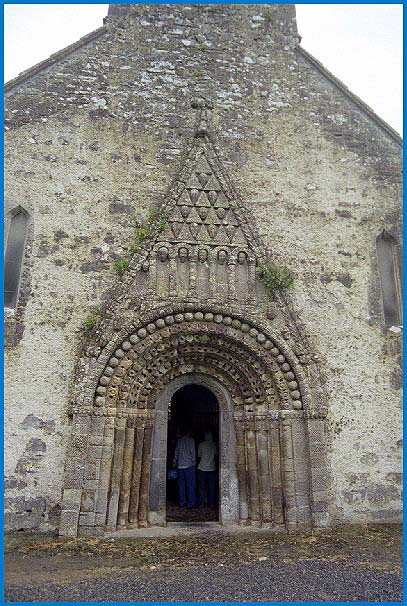
Clonfert, Ireland, 1200+-year-old cathedral.
Photo © 2001 Christy K Robinson

My ancestors came from several places on their emerald isle: Dublin, County Antrim, central Ireland, Cork, and elsewhere. They bore names like McClure, McCullough, Swinney, McFatridge (McFetrick), Neal, and Allen.

Practically in the center of the island is the diocesan Cathedral of Clonfert, Church of Ireland in the Anglican Communion, which is Protestant in a country dominated by Roman Catholicism. 

This County Galway church started as a small Romanesque barrel-vaulted space, possibly as early as 600-800AD. The spherical objects around the doorway are carved heads (saints? clan chieftains?), probably reminiscent of the Celtic belief that if you take an enemy's head, you take its power. Some of the spheres have faces, and others look like brain cortex, with curvy vine figures on the surface.

In the 1100s, when the Celtic church was reformed and conformed to the Roman church, Clonfert was enlarged, the roof raised, and a west tower was added, which accounts for the rest of the wide face of stonework.

 On the south wall of the chancel is a small 15th-century stone carving of a mermaid holding a Gospel book in her hand, signifying St. Brendan the Navigator, who was a seafaring missionary. Legend says that he and 14 monks reached America and returned to Ireland. Their leather-covered sailboats are described HERE. St. Brendan's story may have been the basis of the story of Prince Madog of Wales, who was said to have landed in North America in the 1100s. See my article on Madog and Nathaniel Jenkins.

Brendan founded a monastery at Clonfert in the 500s which is rumored to have taught both boys and girls in its school. St. Brendan is allegedly buried there. The church was built later, perhaps in the 800s, and in the 1100s, the church was enlarged by the Norman occupiers. There probably were north and south transepts which gave a cross shape to the church, according to archaeological studies, but for hundreds of years the chancel and nave have had a rectangular shape.

Google map of Clonfert
Google street view of Clonfert Cathedral
There's not much evidence of where, specifically, our Irish ancestors came from because of political and social upheaval. But we can close our eyes and listen to the echoes and whispers of a thousand years ago.


*****
Christy K Robinson is author of these books:
Mary Dyer Illuminated Vol. 1 (2013)  
Effigy Hunter (2015)  

And of these sites:  
Discovering Love  (inspiration and service)
Rooting for Ancestors  (history and genealogy)
William and Mary Barrett Dyer (17th century culture and history of England and New England)
Editornado [ed•i•tohr•NAY•doh] (Words. Communications. Book reviews. Cartoons.)

Monday, June 11, 2018

A dodgy legend cited in 1733

Rabbit trails to the ancestors 

© 2018 Christy K. Robinson

 While researching the lives and stories of your ancestors, have you ever lost the thread of your original search when you find a different ancestor and a previously unknown factoid, which you must sniff out? That happens to me all the time. It's called a rabbit trail. The idea is that a rabbit meanders through a yard, randomly nibbling on the garden, then leaves the scene before a dog comes along and tries to sniff out its scent.

I was looking for information on ancestor Giles Slocum's excommunication from the Baptist Church of Portsmouth, Rhode Island, and found an old book called Materials Towards a History of the American Baptists (by Morgan Edwards, 1770). Paging through, I recognized names of several ancestors including Rev. Nathaniel Jenkins (seventh great-grandfather), of whom I've written elsewhere in this site.

Rev. Jenkins was one of a wave of immigrant Welsh Baptists who ministered in New Jersey and Pennsylvania from the late 1600s to the late 1700s. He arrived in 1712, married to Esther Jones, with a family of three small daughters and a toddler son. Five more children were added until 1729.

Immediately, he went to work in a loan office, and was elected to the colonial legislature, as well as serving as pastor of the Baptist church in Cape May, New Jersey, a whaling community. Though I can't find details of what "bloody flux" caused a major epidemic and die-off in New France and New England and the ports of New Jersey, some historians think it was measles or dysentery making the rounds from 1714-1720. Rev. Jenkins had to comfort the dying and their families.

In 1721, Jenkins was able to stop an assembly bill that would have punished people who held different religious beliefs than the majority of Christians, including him. See Another Brick in the Wall of Liberty.

In addition to preaching at Cape May, he spoke often at churches in Pennsylvania and New Jersey. In 1728, he was called to pastor at Shiloh, New Jersey, where he served both "Keithians" or Seventh-day Baptists, and Baptists who met on Sundays.

Good man! Educated, well respected, hard working, advocated for the right to religious liberty, was beloved by his parishioners, and esteemed by his colleagues.

In 1559, in the first years of Queen Elizabeth's reign in England, a Welshman named Humphrey Llwyd published Cronica Walliae, a history of Wales that included a legend that Prince Madog ap Owain of Gwynedd had tired of fraternal fighting for the Welsh crown after Owain died in 1170, and had sailed away to discover America. He formed a colony of Welsh people among Native Americans. He returned to Wales and brought another ship of Welsh people and supplies back to North America. After that, there was no report of him.

Politically, this colonization by a Welsh prince could mean that Spain's claim on the New World through Cristobal Colon (Columbus) would be negated and the British could lay claim to the continent by right of first discovery 300 years before Columbus. Don't forget that Spain and England were enemies, mostly over Catholic/Protestant issues, but also over trade. The story grew in the 1700s, with the addition that this tribe of Welsh Indians had beards. A legend grew that Madog's people had built stone structures like a castle, laid out streets, and eventually had children with the Indians. Early explorers were supposed to have met Indians who could understand or speak Welsh. The thought was that Madog had sailed west to America and north on the Mississippi River and his colony had integrated with and become the Mandan tribe of North Dakota. There is, of course, no evidence or even a slight possibility that a Prince Madog ever came to America, but why would that stop a Welsh storyteller from promoting the myth on a long winter's evening? The tale was told for more than 300 years. Even Thomas Jefferson told Merriwether Lewis to investigate whether this story was a possibility, in 1803.

In 1733, when Rev. Jenkins was 54 years old, he and some colleagues wrote a letter to the British Missionary Society, which is contained in the 1770 Baptist history book. This is the explanation of the letter, and the letter itself.

 ***** 
           Morgan Edwards wrote: "Though it be doubtful whether a nation of ancient Britons (usually called Welsh Indians) 
do exist in America yet the grounds of the conjecture are not to be despised. It is no longer than 1767 
since some Indians from the back of lake Superior averred at Quebec 
"That far westward of them was a tribe of white people who wore beards, and dressed differently 
from the Spaniards, French and English; that they had the use of arms, possessed a well improved 
country, but were very shy of the black Indians, &c." 
           See the account published at London in the Ledger of Feb. 2, 1768. However, our forefathers believed there were such a people, as appears by their letters, one of which (addressed to the British [Missionary] Society, and dated Philadelphia, Mar. 1, 1733-4) is as followeth. 

Gentlemen,
It is not unknown to you that Maddoc Gwynedd, prince of Wales did, about 500 years ago, sail to the westward with several ships and a great number of his subjects; and was never heard of after. Some reliques of the Welsh tongue being found in old and deserted settlements about the Mississippi, make it probably that he sailed up that river. And we, being moved with brotherly love to our countrymen, are meditating to go in search of them; but are discouraged by the distance of the place, and uncertainty of the course we should steer. If you can give us any information and direction, together with some help to bear the expence we shall find men adventurous enough to undertake the expedition; having no other end in view than to carry the gospel of peace among our ancient brethren; and believing it will be to the enlargement of the british Empire in America, and a proof of prior right to the whole continent, should we happily succeed."

We remain, Gentlemen, Your loving countrymen,
Nathaniel Jenkins, John Davis,
Benj. Griffiths, David Evans,
Joseph Eaton, Rynallt Howel.

 *****
 Keep in mind the context here. This is British colonial America, 40 years before the Revolution, and 70 years before the Lewis & Clark Expedition to the West Coast. The Welsh ministers of Pennsylvania and New Jersey had been born and educated in Wales, and had spent decades already in America, without returning to their native country for a professional visit or vacation. Learning a Welsh story about their ancestors would have quickened their hearts. Combined with missionary zeal, it would have been very exciting to meet their "cousins" and convert them to Christianity.

For more information on the legend of Prince Madog and the Welsh Indians, click HERE.


*****
Christy K Robinson is author of these books:
Mary Dyer Illuminated Vol. 1 (2013)  
Effigy Hunter (2015)  

And of these sites:  
Discovering Love  (inspiration and service)
Rooting for Ancestors  (history and genealogy)
William and Mary Barrett Dyer (17th century culture and history of England and New England)