CRIME AND CONVIVIALITY: THE SOCIAL SPACE OF "The sentence was passed upon you; you must return to the prison and there remain until tomorrow at nine o'clock; then from thence you must go to the gallows, and there be hanged till you are dead." ~Gov John Endicott, Massachusetts Bay Colony--said to Mary Barrett Dyer, my ancestor, May 31, 1660, 350 years ago.
And on June 1, 1660, Mary was taken from the jailhouse to the gallows on Boston Common. So that the large crowd of onlookers would not be able to hear her voice, drummers accompanied the militia as she walked the mile to the gallows where she died.
_____________
Mary Dyer was banished from Boston for her religious beliefs, but kept returning under conviction that she must speak what God revealed to her. The first occasion was as an Antinomian in 1638. The Puritans who governed Massachusetts Bay Colony were themselves refugees from the Anglican repression of Calvinism. They believed that civil and religious government were one fabric, and based their civil laws upon the Ten Commandments. They believed also that they were special and chosen of God, and that their piety and strict adherence to the Law proved to each other and to God that they were, indeed, predestined for eternal salvation.
This may seem foreign to contemporary Protestants and evangelicals who believe that salvation is only by God’s gift—grace—to anyone and everyone who accepts the gift. But there are many people and groups today who say that yes, they’re saved by grace, but because they love the Lord who saves them, they must “prove” their love by keeping the law of the Old Testament. They misunderstand Jesus’ statement, “If you love me, keep my commands,” because it’s taken out of context. Jesus’ command (not the Ten Commandments) in that context is simply to love one another as he loves us.
Antinomians believed that the Bible’s entire Old Testament law (nomos in Greek) was made null and void when Jesus died on the cross. There was no distinction between the ceremonial regulations (sacrifices and rituals, clean/unclean activities and foods) and the moral law (Ten Commandments). Nomos meant the entire kit and caboodle.
As believers in Jesus, Christians are no longer under the covenant of keeping the Law, Antinomians believed.
“For sin shall not be master over you, for you are not under law but under grace.” Romans 6:14
“But now, by dying to what once bound us, we have been released from the law so that we serve in the new way of the Spirit, and not in the old way of the written code.” Romans 7:6
“Through Christ Jesus the law of the Spirit of life set me free from the law of sin and death.” Romans 8:2
“By calling this covenant "new," he has made the first one obsolete; and what is obsolete and aging will soon disappear.” Hebrews 8:13
So if we don’t keep the old Law any more, are we free to participate in chaos, and do as we please, hurting ourselves and others? No, says Paul the apostle. Now we are accountable directly to God himself, subject to the new Law he writes on our minds and hearts (conscience). We have lists in the New Testament of behaviors and attitudes which will keep us from intimacy with God, and keep us from entering his kingdom: murder, fornication and adultery (sex outside marriage), theft, lying, gossip and slander, dishonoring our parents, greed, drunkenness, and others.
“For this is the covenant that I will make with the house of Israel after those days, saith the Lord; I will put my laws into their mind, and write them in their hearts [direct revelation or Inner Light]: and I will be to them a God, and they shall be to me a people: And they shall not teach every man his neighbour, and every man his brother, saying, Know the Lord: for all shall know me, from the least to the greatest [there goes the theory of the Elect]. For I will be merciful to their unrighteousness, and their sins and their iniquities will I remember no more.” Hebrews 8:10-12
Here is where Mary Dyer and other Antinomians based their beliefs that the old Law was obsolete and useless, and the new Law was personally and directly revealed to them by the Holy Spirit. In later years, when Mary espoused the Quaker beliefs, direct revelation was called the Inner Light.
But back to the Puritans: If you destroy the foundation of their belief, the Law, there is nothing left to hold onto, because faith in God’s grace is not enough security. You just cannot have people running around doing as they please, excusing themselves by saying that God told them to do this or that. There needs to be a structure! There’s nothing that distinguishes the law-keepers from the Catholic or apostate-Protestant herds. The entire multibillion-dollar institution crashes. The worldwide "we're the exclusive Remnant/Elect of God, and only we will be saved" thing is gone. They can't handle it spiritually, emotionally, or intellectually. They also can’t handle it financially. The Massachusetts Bay Colony was a business venture, chartered by King Charles I.
I understand, in a way. When you've believed wholeheartedly in God’s will, that this promise or this distinctive is a special gift to you, it's part of your very fabric. Pull some threads or cut a hole, and it's not salvageable. It’s too difficult, and maybe even too late in life, to start all over and learn everything new, especially when you’ve been “right.” How does one hold one's head up with constituents, parishioners, faith adherents? There’s no putting new wine into an old wineskin or patching a cotton tear with wool. What about prophesied end-time events? We’ve been denying ourselves and living a hard life, and these unworthy people get to waltz into heaven while we trudge there? What about judgment (who flies and who fries)? What if we stop observing a law-decreed Sabbath on Saturday or Sunday--and start trusting in God for complete rest from our strivings and a sabbath-rest that blesses us today and every day? What will distinguish us, the Remnant and the Elect, from the unwashed and uncouth? We’d have to go out of business, retrain every pastor, retool every institution from preschool through university and seminary, and worst of all, change the minds and hearts of those who have believed what they were taught for generations. It’s unthinkable!
Puritans were so sure they were “right” that there was no room for dissent. (This from reformers and dissenters to the Church of England!) There was no agreeing to disagree. There was only consensus—agreeing to agree. And if, after being shown your errors in theology and behavior, you didn’t agree, you’d be punished. The church/state government, and all of society, was in danger of collapse if people just did and believed as they wanted.
In 1637-38, Mary and William Dyer and 75 other families followed Anne Hutchinson in the Antinomian Controversy, and were disfellowshipped (excommunicated or disfranchised) from the Puritan congregations of Boston.
They moved to Rhode Island and founded two communities, Portsmouth and Newport, under extremely primitive conditions. They built homes and planted farms and worshiped according to conscience. Four years later, Massachusetts Governor Winthrop sent a manuscript to England that was published as a lurid and vicious description of Mary’s stillborn anencephalic baby, and Anne Hutchinson's hydatidiform mole pregnancy, and called them monsters, proof of their heresy in 1637-38. (It was a Winthrop PR campaign to show his awesomeness and worthiness to be the governor of the colony.)
In 1652, Mary traveled back to England and stayed for five years. She followed the doctrines of George Fox, founder of the Quaker (Religious Society of Friends) movement, and sailed back to Rhode Island via BostonHarbor in 1657. She and her friends were arrested from shipboard and taken to prison, where they stayed for several months. Their crime: being Quakers, when the colony, now governed by John Endicott, had ruled that Quakers would be imprisoned and banished—after having been dragged behind a wagon and scourged, and losing their ears. One of Mary’s shipmates, a woman, was stripped to the waist and scourged, and another was sent back to England, but Mary was released to her husband in Rhode Island as a professional courtesy because he was a government official—and not a Quaker.
Mary returned to Massachusetts in 1658 to visit her imprisoned Quaker friends and was expelled. She preached in New Haven, Connecticut, and was arrested and expelled from that colony. In 1659, she learned that two Quaker men had been imprisoned in Boston, and she walked through the forest on Indian trails to visit and comfort them in prison. She was arrested again, and tried in Governor Endicott’s court. Mary was convicted and actually sent to the gallows. Her friends were hanged before she was placed in the noose with a cloth over her face—but was reprieved on condition she would not return to Boston. She actually seemed disappointed in the reprieve and "rescue" by her husband and eldest son, as she was protesting religious repression and willing to die with her Quaker colleagues. She was admonished not to return upon pain of death.
After six months of preaching to the Indians and Quakers of Long Island and Connecticut, she went back to Boston without telling her husband or six children who lived in Rhode Island. Her Quaker brothers and sisters were being tortured and their property confiscated. She went directly to the jail and asked to speak to the prisoners. She was arrested, jailed for more than a month, convicted again, and hanged on June 1, 1660.
Why did Mary seem to have a death wish? She had a husband who loved her, and six children, aged 10 to 25, yet she didn’t stay with them very much during the two years before her execution, and after her five-year absence in England.
Analyzing her beliefs and letters, Mary Dyer seemed to have the biblical book of Hebrews written on her heart. This passage jumped out at me today as I was researching this post. I’ve bolded the phrases that apply to Mary, and you can see how closely they align with her actions just before her arrests, imprisonments, and execution.
“Remember those earlier days after you had received the light[direct revelation of God, or the Quaker “Inner Light”] when you stood your ground in a great contest in the face of suffering. Sometimes you were publicly exposed to insult and persecution; at other times you stood side by side with those who were so treated. You sympathized with those in prison and joyfully accepted the confiscation of your property, because you knew that you yourselves had better and lasting possessions. So do not throw away your confidence; it will be richly rewarded. You need to persevere so that when you have done the will of God, you will receive what he has promised.” Hebrews 10:32-36
Mary joyfully accepted her martyrdom, believing that her death would so shock the system that Endicott and his court would have to back down from their repression. She died so that others could live and worship in freedom of conscience. She did not die in vain.
The dedication on Mary's statue in Boston says "WITNESS FOR RELIGIOUS FREEDOM." Mary died for the basic human right to worship and express her religious beliefs as she felt called by God to do. She was the only woman hanged for religious beliefs, and only one more Quaker man was hanged after her, because of outcry in both New England and Britain over their persecution and executions.
Massachusetts Bay Colony, like many business, political, and religious organizations, was dedicated to control of the institution (self preservation), the church, and its people en masse. Mary understood that Jesus came as a man to relate to and save the individual. She and the others died for one of the principles America holds most dear: the liberty of the individual to follow conscience.
Archaeologists searching for the burial place of Charlemagne have failed to find any evidence that the body of the Carolingian emperor was placed in the atrium of Aachen Cathedral.
Andreas Schaub has led a team of archeologists for over three years in an attempt to find the exact spot within the cathedral where the medieval ruler was buried on the 28th January 814. But the dig within the atrium of the 8th century cathedral has only turned up material dating back to the 13th century.
There have been several archaeological investigations of the cathedral. Andreas Schaub noted that "since the 1980s, the theory persisted that the grave is in the atrium." With this news, focus on the whereabouts of Charlemagne will turn to the Cathedral's Court.
Charlemagne was buried in Aachen on the same day he died. Although the Carolingian emperor had previously made it known that he was to be buried near Paris, his court officials decided to bury him in Aachen because of the difficulty in transporting his body in cold weather.
The body of Charlemagne has had an eventful existence since his death. In the year 1000, Otto III had Charlemagne's vault opened. The Chronicle of Novalesia records how Otto and one of his courtiers saw when they entered the vault:
"So we went in to Charles. He did not lie, as the dead otherwise do, but sat as if he were living. He was crowned with a golden crown and held in his gloved hands a sceptre; the fingernails had penetrated through the gloves and stuck out. Above him was a canopy of limestone and marble. Entering, we broke through this. Upon our entrance, a strong smell struck us. Kneeling, we gave Emperor Charles our homage, and put in order the damage that had been done. Emperor Charles had not lost any of his members to decay, except only the tip of his nose. Emperor Otto replaced this with gold, took a tooth from Charles’s mouth, walled up the entrance to the chamber, and withdrew again."
In 1165, Emperor Frederick Barbarossa again opened the vault and placed the remains in a sculptured sarcophagus made of Parian marble, said to have been the one in which Augustus Caesar was buried. The bones lay in this until 1215, when Frederick II had them put in a casket of gold and silver. A vellum codex found interred with him was removed.
There have been eight theories about the burial place of the Carolingian ruler. "We have definitely ruled out five of these with the recent excavations," explained Cathedral architect Helmut Maintz. "But there are fortunately a few theories left, so I am not hopeless."
This man would not have been my ancestor if he hadn't been a kidnapper. People joke that their ancestors may include horse thieves, but this man stole a human being. A teenage girl.
The author, Christy K Robinson, with a wooden statue of Ralph Stafford, at the Stafford Castle visitor center.
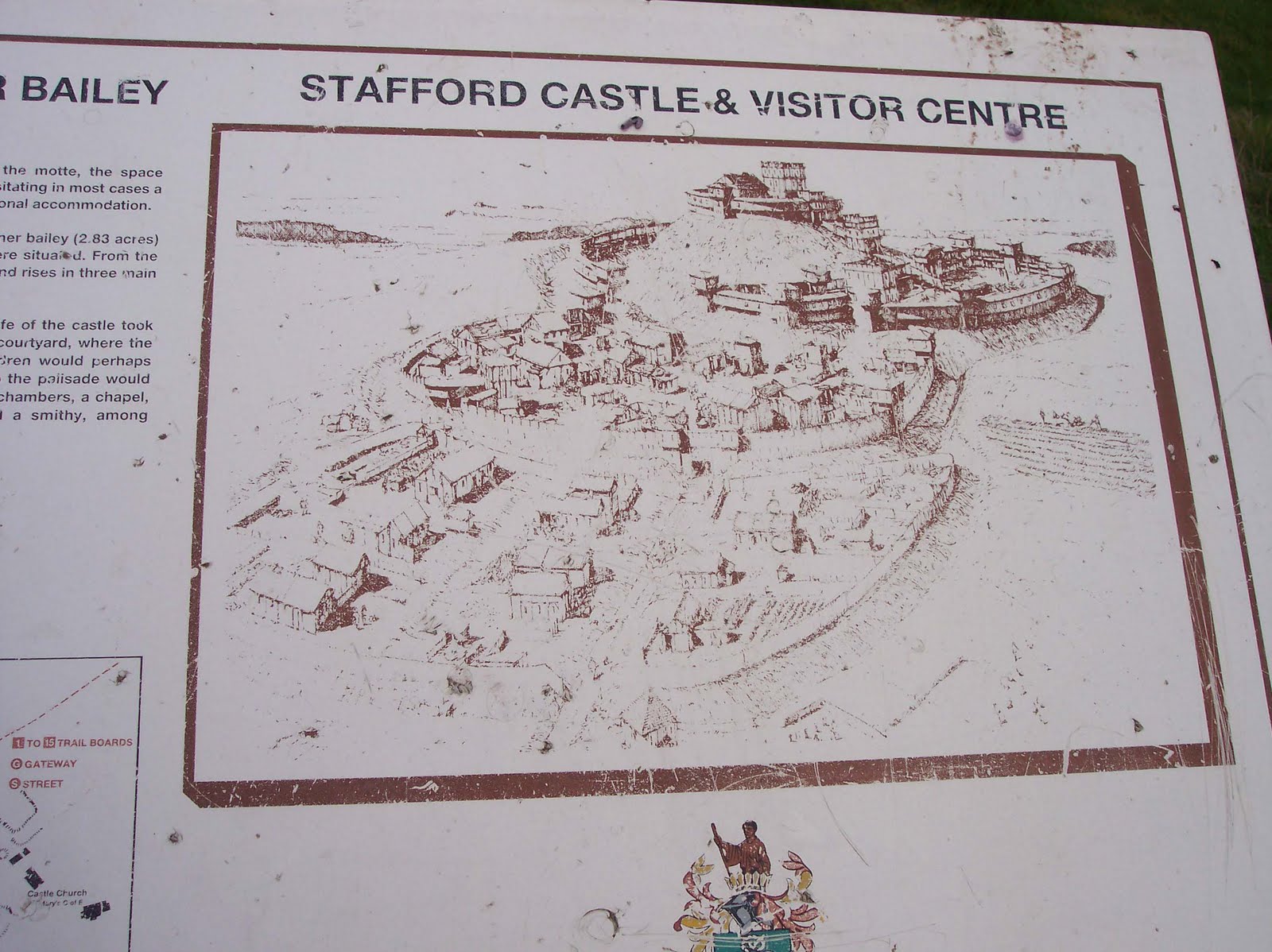
Ralph de Stafford’s genealogy is known back to about 945 in Normandy, and from Ralph to me there are 23 generations. His family owned many estates in Staffordshire after the Conquest, and his sixth great-grandfather built the first Stafford Castle before his death in 1088.
Through his son and heir Hugh Stafford, Ralph is the grandfather of Margaret Stafford Neville, countess Westmoreland, first wife of Ralph Neville; Ralph de Stafford’s Neville great-grandchildren married Scrope, Ferrers, and Percy families, among others. Margaret’s son Ralph Neville was heir to Neville titles, although most of the lands and money went to his mother-in-law, Joan Beaufort, and her children by John of Gaunt.
But the way Ralph Stafford got his heir is the most interesting thing about him!
…1301-24 September, born in Stafford, to Edmund, First Baron Stafford and his wife Margaret Bassett.
…1308-Ralph succeeded his father as Lord Stafford. His mother Margaret remarried to Thomas Pype.
…1314-1321-The Great Famine strikes northwestern Europe, killing more than 10 percent of the population. Typhoid and anthrax plagues sweep Europe in the next decades.
…1315? Along with his brothers and stepfather, Ralph joined the retinue of Ralph, 2nd Lord Bassett (his mother’s brother.)
…1326/27-Ralph married Katherine Hastang, daughter of Sir John Hastang of Chebsey, Staffordshire & his wife Eve. Katherine Hastang is my “cousin” because she’s descended from Mortimer, de Braose, and Llewellyn. http://fabpedigree.com/s043/f662009.htmPresumably she died in childbirth, as I find no mention of annulment of their marriage, and Ralph literally “takes” a new wife less than 10 years later.
Ralph Stafford and Katherine Hastang had two daughters: …….Margaret Stafford, married Sir John of Bramshall (or Wickham) de Stafford, Knt. (Margaret Stafford-Stafford?)
…….Joan Stafford, married Sir Nicholas de Beke, Knt.
…1327- Ralph supports plot to overthrow Roger Mortimer and Queen Isabella’s regency of England. This gains support from Edward III. (Ralph and Roger will be co-grandparents in about 50 years!)
…1327- Ralph made Knight banneret, a higher rank than knight bachelor, and was fighting Scots shortly afterward.
Stafford Castle in 1100
…1332-Ralph was a commissioner of the peace in Staffordshire and had served abroad on royal business, accompanying Hugh d’Audley, ambassador to France. Four years to the Big Event.
…1332- Ralph commanded archers at the Battle of Dupplin Moor on 11 Aug 1332 and on three further Scottish campaigns.
…1336-Calendar of Patent Rolls 1334-1338, p. 283. “28 February 1336: Commission to Robert de Bousser and Adam de Everyngham to find by inquisition in the county of Essex what persons broke the close of Hugh de Audele at Thaxstede, carried away his goods and abducted Margaret his daughter; and to certify the king fully of the whole matter.”
Hugh d’Audley was not aware at that time who had abducted his daughter. It seems he didn’t find out until at least June of that year.
…1336- 6 July: Calendar of Patent Rolls 1334-1338, p. 98: The like [commission of oyer et terminer] to Richard de Wylughby, Thomas de Loveyne, Thomas Gobyon and Robert de Jedeworth, in the counties of Cambridge and Essex, on complaint by Hugh Daudele that Ralph de Stafford, Ralph son of Ralph Basset [cousin], William Corbet, John de Seyntper, Richard de Stafford [brother], John de Draycote, John de Stafford, Humphrey Hastang, James de Pype, Roger Mychel, James de Warden, Richard de Merton, Geoffrey Byroun, John Larcher, Simon de Boseworth, Robert de Rashale, Richard de Hastang, William de Hastang, John de Stafford, 'squier,' and others, broke his close at Thaxtede, carried away his goods, abducted Margaret his daughter and heir, then in his custody, and married her against his will.”
The Pypes were his step-brothers or half-brothers. Bassets were his mother’s relatives. Hastangs were his in-laws by his first wife. This raid must have been carefully planned to include more than 20 people, and to succeed in objective! I wonder if there were other potential brides considered and rejected before Ralph settled on Margaret d’Audley. Margaret had a large inheritance, and was the great-granddaughter of Edward I through her mother, Margaret de Clare (Gaveston).
…1336- Ralph married “against [her father's] will” (but what was her will?) the heiress Margaret d’Audley, aged between 14 and 18, but probably about 14 or 15 at the time of her abduction. Ralph was 34 years old, 20 years older than his kidnapped bride, and 11 years younger than his new father-in-law, Hugh d’Audley. Hugh and Margaret protested the kidnapping and marriage, but Edward III allowed it to stand, and created Hugh first Earl of Gloucester as appeasement to Hugh’s “wrath,” as some writers have called it. It seemed to be Hugh’s lifetime ambition to get his wife’s de Clare inheritance brought back to his holdings, and this was his way in. It also meant he got back what Hugh Dispenser the Younger had usurped about 15 years before.
Since Margaret d’Audley, an heiress, was so “old” to be still single, I wonder if Ralph Stafford had made an offer for Hugh’s daughter and been refused because Ralph wasn’t offering a Gloucester property in the deal, or if Ralph just swooped in when he found an opportunity. Hmmm…
…1336-November. First of five (or six or nine) children with Margaret is born, Joan Stafford (1336-1397). Oddly, Ralph named two daughters Joan! Apparently, Ralph wasted no time or opportunity to consummate the forced marriage and get his bride pregnant, because she was already four or five months gone when the complaint was issued in early July. Joan Stafford married 1: John Cherleton (B. Powis); married 2: Gilbert Talbot (3° B. Talbot) before 16 Nov 1379.
…1337-their son Ralph born (1337-1347). As a child, Ralph was contracted to marry the daughter of Henry of Grosmont, but Ralph Jr. died at about age 10.
…1337- summoned to Parliament by Writ as the 2nd Baron Stafford from 1337 to 1350.
…1338-Daughter Katherine born (1338-1361), married Sir John de Sutton, Knt., Baron of Dudley, Staffs.
…1338-Ralph accompanied Edward III to France in 1338 as an advisor.
…1340-Daughter Beatrice born (1340-1415), Married 1: Maurice Fitzmaurice Fitzgerald (2° E. Desmond) 1350; Married 2: Thomas De Ros (5º B. Ros of Hamlake) 1 Jan 1357/58.
…1341-Ralph appointed Steward of the Royal Household.
…1344-Son Hugh Stafford born (1344-1386), married Philippa Beauchamp, daughter of Thomas Beauchamp, earl of Warwick, and Katherine Mortimer.
Philippa Beauchamp was granddaughter of Roger Mortimer, 1st Earl of March, who her father-in-law Ralph Stafford helped to overthrow from regency, and was eventually executed horribly for treason. Hugh and Philippa's child was Margaret Stafford, who married Ralph Neville, 1st earl Westmorland. Margaret Stafford and Ralph Neville were second cousins, as both were descended from siblings Hugh d'Audley and Alice d'Audley.
…1345-Ralph resigned as Steward of the Royal Household, and became Seneschal of Aquitaine.
…1346-Ralph participated in the English victory at the Battle of Crecy. Further battles included the battle of Auberoche, the siege of Aiguillon, from where he escaped prior to its lifting, a raid on Barfleur and the English victory at the Battle of Crecy, on 26 August 1346.
…1347, November-Hugh d’Audley, earl of Gloucester, Ralph’s father-in-law, dies, dramatically increasing Stafford’s considerable wealth from his existing lands and war prizes and ransoms.
…1348-Ralph de Stafford invested as Knight of the Garter, founding member.
…1348-1350-Bubonic plague pandemic kills half to three-quarters of the population of England, alters economy forever.
…1350-5 March, Ralph created Earl of Stafford. Becomes the king's lieutenant in Gascony.
…1350 or 1351-Margaret d’Audley, Baroness Audley, Countess Stafford, dies, probably from childbirth, aged about 32 or 33; is buried with her parents at Tonbridge Priory in Essex. “Radulphus comes Stafford et dominus de Tonebrugge” donated property to Cold Norton Priory, for the soul of “Margaretæ uxoris nostræ” [Margaret his wife], by undated charter witnessed by “Hugone de Stafford filioet hærede nostro [son and heir], Ricardo de Stafford fratre nostro [brother], Johanne de Peyto consanguineo nostro…”http://bit.ly/jAEW4a
…1361- Stafford continued to command troops and act as a royal envoy, both in France and in Ireland in 1361, accompanying Lionel of Antwerp to try and restore English control.
…1372-31 August, Ralph died at Tunbridge Castle, buried at nearby Tonbridge Priory.
***********************************************
If you enjoy life sketches, anecdotes, and historical details like these, you can find them in the book Effigy
Hunter, by Christy K Robinson.
Joanna de Kilpeck de Bohun, Countess of Hereford, was not my ancestor. She’s the ancestor of no one, having died without issue. But she has a beautiful tomb effigy in the Lady Chapel at Hereford Cathedral, so I have decided to resurrect her in 2009. Joanna would have known Hereford Cathedral as the Church of St. Mary the Virgin and St. Ethelbert the King.
Her father, Alan Plukenet, died in 1299 after a career as a knight and baron who fought for King Henry III at Evesham. On his lands at Kilpeck, a village and castle (painting of castle here) with a Romanesque church, Alan drained wetlands and created the parish of Allensmore. Alan was a benefactor of Abbey Dore, and was interred there.
His son and heir, also Alan Plukenet, was summoned to Parliament. Edward I granted the second Alan a charter to hold a market in Kilpeck, about 8 miles from Hereford. When Alan died in about 1315, his heir was his sister Joanna. She did homage to King Edward II and had livery of Kilpeck and the Plukenet/Plunkett holdings in the 19th year of Edward II, or 1326.
Several sources say that Joanna was the wife of Humphrey de Bohun, Earl of Hereford. Another, www.herefordwebpages.co.uk, says that she was married to William de Bohun, Earl of Northampton. The source of the family list below Wikipedia cites Edward de Bohun marrying “Joan Plokenet,” but he wasn’t the Earl of Hereford.
[BREAKING NEWS--Be sure to read Terry's comments below this article for his research (and corrections) for the Plunkett family.] The purpose of this article is to discuss Joanna's tomb at Hereford Cathedral, not to trace her family genealogy.
There are far too many Humphrey de Bohuns for comfort, so here is a family list with all the Humphreys in bold (with my ancestors Eleanor and Agnes in red). The father, Humphrey VIII (1276-1322), was Earl of Essex and Hereford. Children of Humphrey de Bohun VIII and Elizabeth of Rhuddlan (daughter of Edward I) were as follows:
.....i. Edmund de Bohun.
.....ii. Hugh de Bohun; born circa 1303; died 1305.
.....iii. Humphrey de Bohun; born 1304; died in infancy 10 Sep 1304.
.....iv. Margaret de Bohun; born before 1 Feb 1304 Tynemouth, Northumberland; died 1311.
.....v. Alianore/Eleanor de Bohun; born 17 Oct 1304; married John de Bromwich; married Sir James le Boteler Earl of Ormond, son of Edmund le Boteler Earl of Carrick (styled) and Joan FitzGerald, 1327, Alianore and James were parents of my ancestor James II Earl of Ormond (Ireland); married Thomas de Dagworth, Lord Dagworth, son of John de Dagworth and Alice FitzWarin, before 20 Apr 1344; died 7 Oct 1363 at age 58. (James II, Earl of Ormond, eventually was granted Kilpeck Castle in Herefordshire!)
.....vi. Mary de Bohun, twin of Humphrey; born 1305; died in infancy 1305.
.....vii. Humphrey de Bohun; born 20 Oct 1305 Pleshy Castle, Essex; died 1310. Age 5 at death.
.....viii. John de Bohun Earl of Hereford & Essex; born 23 Nov 1306 St. Clements, Oxfordshire; married Margaret Basset, daughter of Sir Ralph Basset V Lord Basset of Drayton and Hawise (Basset), after 1308; married Alice Fitzalan, daughter of Sir Edmund Fitzalan Earl of Arundel and Alice de Warenne, 8 Mar 1325; died 20 Jan 1335 Kirkby-Thore, Westmorland, at age 28; buried after 20 Jan 1335 Stratford Abbey, London. He was also known as John de Bohun.
.....ix. Edward de Bohun; born 1307 of England.
.....x. Humphrey de Bohun IX Earl of Hereford; born 6 Dec 1309 at Caldecot, Northampton; died 15 Oct 1361 at age 51. He was buried at Walden Abbey in Essex.
.....xi. Margaret de Bohun; born 3 Apr 1311 of Caldecot, Northamptonshire; married Sir Hugh de Courtenay III Earl of Devon, son of Sir Hugh de Courtenay II Earl of Devon and Agnes de St. John, 11 Aug 1325; died 16 Dec 1391 Exeter, Devonshire, England, at age 80. Buried in Exeter Cathedral with lovely effigies—I have a photo.
.....xii. Edward de Bohun; born 1312 of Caldecot, Northampton; married Joan Plokenet??; married Margaret de Ros; died 1334. If Edward married Joanna Plukenet, he’d have died three years before her and could not have married Margaret. Furthermore, he was not the Earl of Hereford, but Joanna was the Countess of Hereford. It can’t be Edward!
.....xiii. Sir William de Bohun, Earl of Northampton.
.....xiv. Aeneas (Agnes) de Bohun; born 1314 of Caldecot, Northampton, England; married (at age 10) as his first wife, Sir Robert de Ferrers 2nd Baron Ferrers of Wemme, son of Sir John de Ferrers Lord Ferrers of Chartley and Hawyse de Muscegros; died 1343 of childbirth. Robert de Ferrers was born on 25 Mar 1309 in Chartley, Staffordshire, England. He died on 28 Aug 1350/1351. He married Aeneas/Agnes de Bohun on 21 Nov 1324 in Caldecot, Northamptonshire, England.
.....xv. Isabel, born 1316, died. Her mother Elizabeth died shortly after childbirth, and they were buried together in Westminster Abbey.
So Humphrey VIII, out of his 15 children, named three of them Humphrey, hoping his heir would carry on the family tradition of Humphrey de Bohun names. The first child died in infancy; the second at age 5, and finally, the Humphrey who stuck around to inherit the titles died at age 51. However, I can find no wife or children for Humphrey IX and I know that Joanna de Kilpeck died without issue, so I will assume that Humphrey IX and Joanna were the pair. When Joanna died in 1337, she was the Countess of Hereford. The references to Joanna in Hereford Cathedral say that she was the wife of Humphrey de Bohun, Earl of Hereford. So that’s what we’ll go with.
“Humphrey de Bohun, 6th Earl of Hereford, 5th Earl of Essex (6 December 1309 – 15 October 1361) was a Lord High Constable of England. He was born to Humphrey de Bohun, 4th Earl of Hereford and Elizabeth Plantagenet and [he was] a younger brother of John de Bohun, 5th Earl of Hereford. He succeeded his elder brother as Earl of Hereford and Essex upon his death on 20 January 1336. He also succeeded John as the Lord High Constable of England, the seventh highest office of the State. [NO MENTION OF HIS WIFE BECAUSE HE HAD NO CHILDREN?] After his death in Pleshey, Essex he was buried in Friars Augustine, London. The Earldoms of Hereford and Essex were passed to his nephew, Humphrey de Bohun, 7th Earl of Hereford, the son of his younger brother William de Bohun, 1st Earl of Northampton, who predeceased him.”
What I can find of Joanna is only about her bequest and her remains—nothing of her life. She must have been born before 1299 when her father died. She made her last charter in October 1337, and died late that year. She may have had cancer or heart disease, because she seemed to know that she was not long for the world. She made gifts shortly before she died.
In the easternmost bay on this side is the tomb of Joanna de Bohun, Countess of Hereford, 1327. To quote from Dean Merewether: " The effigy of the lady, there can be scarcely a doubt, represents ' Johanna de Bohun, Domina de Kilpec.' She was the sister and heiress of Alan Plonknett or Plugenet of Kilpec, in the county of Hereford, a name distinguished in the annals of his times; and of his possessions, his sister doing her homage, had livery 19 Edward II. [1326]
"In 1327 Johanna de Bohun gave to the Dean and Chapter of Hereford, the church of Lugwardyne, with the chapels of Llangarren, St. Waynards and Henthland, with all the small chapels belonging to them, which donation was confirmed by the king by the procurement and diligence of Thomas de Chandos, Archdeacon of Hereford; and the Bishop of Hereford further confirmed it to the Dean and Chapter by deed, dated Lugwas, 22nd July, 1331 (ex Regist. MS. Thomae Chorleton, Epi.): And afterwards the Bishop, Dean and Chapter appropriated the revenues of it to the service peculiar to the Virgin Mary, ' because in other churches in England the Mother of God had better and more serious service, but in the Church of Hereford the Ladye's sustenance for her prieste was so thinne and small, that out of their respect they .add this, by their deeds, dated in the Chapter at Hereford, April toth, 1333.' (Harl. MS. 6726, fol. 109.)
" Johanna de Bohoun died without issue, 1 Edward III., 1337, the donation of Lugwardyne being perhaps her dying bequest. On the 17th of October in that year, she constituted form de Badesshawe, her attorney, to give possession to the Dean and Chapter of an acre of land in Lugwardine, and the advowson of the church with the chapels pertaining to it. This instrument was dated at Bisseleye, and her seal was appended, of which a sketch is preserved by Taylor, in whose possession this document appears to have been in 1655, and a transcript of it will be found Harl. MS. 6868, f. 77 (see also 6726, f. 109, which last has been printed in Shaw's Topographer, 1. 280).
"In the tower is preserved the patent 1 Edward III, pro Ecclesia de Lug-warden cum capellis donandis a Johanna de Bohun ad inveniendum 8 capellanos et 2 diaconos appropri- anda (Tanner's Notitia Monast.').
"The circumstances above mentioned appear sufficiently to explain why the memorial of Johanna de Bohoun is found in the Lady Chapel, to which especially she had been a benefactress. They also explain the original ornaments of this tomb, the painting which was to be seen not many years since under the arch in which the effigy lies, now unfortunately concealed by a coat of plaster, of which sufficient has been removed to prove that Gough's description of the original state of the painting is correct. He says, 'The Virgin is represented sitting, crowned with a nimbus; a lady habited in a mantle and wimple kneeling on an embroidered cushion offers to her a church built in the form of a cross, with a central spire—and behind the lady kneel eleven or twelve religious, chanting a gorge deployee after the foremost, who holds up a book, on which are seen musical notes and "salve sea parens.' Fleur-de-lys are painted about both within and without this arch, and on the spandrils two shields; on the left, a bend cotised between twelve Lioncels (Bohun); and on the right, Ermines, a bend indented, Gules.' This description was published 1786.
"By this painting there can be no doubt that the donation of the church of Lugwardine was represented, the eleven or twelve vociferous choristers were the eight chaplains and two deacons mentioned in the patent, who were set apart for the peculiar service of the Lady Chapel, and provided for from the pious bequest of Johanna de Bohoun. The two shields mentioned by Gough are still discernible, that on the dexter side bearing the arms of Bohun, Azure a bend, Argent between two cotises, and six lions rampant, or. —The other, Ermines, a bend indented, (or fusily) Gules, which were the bearings of Plugenet, derived perhaps originally from the earlier Barons of Kilpec, and still borne by the family of Pye in Herefordshire, whose descent is traced to the same source. In the list of obits observed in Hereford Cathedral, Johanna is called the Lady Kilpeck, and out of Lugwardine was paid yearly for her obit forty pence."
The effigy of Joanna de Bohun is also valuable as a specimen of costume. Its curious decoration of human heads is also noteworthy.
About those “human heads” on the arch. I wonder if, as was sometimes done, one of the heads represented Isabella of France, Queen of England, wife of King Edward II. Edward II was the uncle of Joanna’s husband Humphrey IX, Earl of Hereford.
The Dean of Hereford, F.S.A., communicated a notice of the burial-place of Joanna de Bohun, on the north side of the Lady Chapel, at Hereford Cathedral, recently disclosed to view during the progress of the restoration of that decayed fabric. In an arched recess in the wall is seen a recumbent effigy, under which a wooden coffin had been deposited in a grave, half the depth of which only was below the level of the chapel. The lid had been covered with linen of fine texture, upon which had been sewn three large crosses pates, and eight smaller ones, formed of white satin: three similar crosses appeared also on each side of the coffin, and four large iron rings at each side and end. The remains had been wrapped in cloth, apparently woollen, fastened with strong packthread: the bones were much decayed, as is usually the case in interments in the Cathedral; but the flowing hair remained perfect, detached from the cranium, like a wig. It was of a yellowish red colour, and so profuse in quantity, that the prevalent notion of the growth of the hair after death, which, as the Dean remarked, had been entertained by him from previous observations, appeared to be confirmed. This lady had been heiress of Kilpec, in Herefordshire, and espoused one of the Bohun family; in the year 1327, she gave the church of Lugwardine, with the chapels of Llan-garrew, St. Waynard's, and Hentland, to the Dean and Chapter of Hereford ; and this donation was subsequently applied to the service of the Blessed Virgin, for which, previously, no sufficient provision had been made in the church of Hereford. It appears by the Obits, that she died in the same year, 1 Edward III [1337]. The foundations and circular apse of the original chapel, succeeded by the beautiful specimen of early English architecture, to which her bequest contributed, had recently been brought to light; the Dean remarked that, in the ante-chapel of this portion of the Cathedral, certain details partaking of Norman character appeared, which are not to be traced in the parts more eastward; and these last, as he supposed, had been constructed subsequently to the gift of the lady of Kilpec.
Joanna’s tomb was covered for several hundred years, and the painting of her presenting the Lugwardine church to Our Lady was covered by white plaster. It was only relatively recently that restorers have repainted her effigy and tomb arch in reds, blues, and gold.
All we know of Joanna is that she was the childless Countess of Hereford, a benefactress of the cathedral in the early 14th century, and that she had masses of yellowish-red hair. If she’d had descendants, we’d know much more about her. But her donations to the Church surely had impact in her lifetime, and could be a lesson to us today. Even the poorest of us have possessions to spare. Take them to a charity shop! You never know what your gifts do to help others, but the same God that Joanna served still honors that faith, and will multiply your donations miraculously.
***********************************************
If you enjoy life sketches, anecdotes, and historical details like these, you can find them in the book Effigy
Hunter, by Christy K Robinson.
In response to an article by Mick Aston about unlocked churches in Anglesey, Wales, I wrote a letter to the editor of British Archaeology, one of the archaeology magazines to which I subscribe. My letter was published in 2007.
Locked out – Star letter
Christy K Robinson
In Anglesey Revisited (Nov/Dec 2006) Mick Aston wrote that "there is much of interest in many of the churches on Anglesey, as elsewhere in Britain". Amen to that. He continued, "Sometimes the churches are not open to travellers". Last September I put 3,500 miles on a hired car, zipping around England and Wales between cathedrals, ruined abbeys, and medieval parish churches, looking for stone tomb effigies of my ancestors (my third such trip). Some churches were open, and I left a few pounds in the offering box as thanks. Then, inexplicably, I was unable to enter others in which I was assured by internet research that my ancestors "resided". It was heartbreaking to be a few feet away from my goal and not able to enter.
At Merevale Abbey near Atherstone, Warks, the manor owner dug up a key and the farm manager's wife let me in to visit my de Ferrers ancestors. At Coverham Abbey in Yorkshire, the property owners allowed me walking access to their beautiful farm, and took a photo of me between my 12th century ancestors' effigies. At Tutbury, Staffordshire, an octogenarian tending her husband's grave not only found a key to the church, but had me in for tea: the quintessential English "thing" this American will long remember. It lessened the sting that one snippy secretary refused admittance to let me take exterior photos of my ancestral castle during business hours on a weekday.
Mr. Aston concluded his article by saying that the "wealth of history, sculpture, architecture and archaeology to be seen in our parish churches makes them an important part of the cultural tourist industry". In a couple years I'll have enough savings to return (the dollar-to-pound exchange is brutal). Like California's "Governorator" Schwarzenegger says, "I'll be back" – investing in your economy via airline and train fares, accommodations, car hire and petrol, admission fees, purchasing books and antique china, and leaving my vat/gst money there, too. By all means, keep those churches unlocked.
Christy K Robinson, Redlands, California
PS As the editor of a 30,000-circulation Christian ministry magazine, I salute Mike Pitts's chutzpah in publishing the interesting assortment of letters in the Nov/Dec issue.
I collect photos of ancestral effigies. I have compiled
a list of burial places for hundreds of ancestors. I’ve even visited many of
the burial places in England,
Scotland, Ukraine, and Paris. There are scores of locations I’ve yet
to visit.
What is an effigy? Dictionary.com says, “a representation or
image, esp. sculptured, as on a monument.”
The medieval effigy gave words to the deceased, which even an illiterate
audience could read: the stone image showed the social status, religious piety,
power, and beauty that the deceased would have at the Resurrection, as well as
a bit of history in the accompanying heraldic insignia: which noble families
contributed to the genealogy, status, dignitas, and wealth of the deceased.
Effigies were, like the pyramids of Egypt, meant to be eternal memorials
to the memory of the deceased. Their depictions were specified in wills.
Realism in depicting the deceased came in a big way during
the reign of Edward III and Philippa (latter half of the 14th century), but
there was a wonderful art patronage during Henry III’s reign a hundred years
earlier, so some effigies may bear resemblance to the person who’s buried
there. In royal personages, there was an attempt at realism in the facial
features of the tomb effigy, while the body and clothing were idealized as the
warrior, the pious, the literate. There are several paintings, bosses, and
sculptures of Eleanor of Aquitaine, that show a beautiful woman with an oval
face. Taken on the whole (if you squint), you can get an idea of her looks.
Similar story with Edward II’s wife Isabella of France.
***********************************************
If you enjoy life sketches, anecdotes, and
historical details like these, you can find them in the book Effigy
Hunter, by Christy K Robinson. It's available in print from CreateSpace, Barnes and Noble, and Amazon.
*********************************************** I like the sweetness of the clasped hands of Katherine
Mortimer and Thomas Beauchamp, Countess and Earl of Warwick, at the church of St. Mary there. (Katherine was daughter
of Roger Mortimer, first Earl of March.)
Katherine Mortimer and Thomas Beauchamp at Warwick. Photo by Christy K Robinson.
The effigies I’ve observed are now bare stone, but many of
them would have been richly painted in blue, red, and gold. The ones of Henry
II and Eleanor of Aquitaine, in France,
have been restored to colorful glory.
Ralph Neville, 1st Earl Westmorland, is the central figure
of an effigy grouping at Staindrop church at Raby, Durham. His first and second wives (Margaret
Stafford and Joan Beaufort, both of whom are my ancestors) are buried
elsewhere, but are depicted in alabaster with Ralph at Staindrop. The women
look the same in features, dress, and age, although Margaret died at age 32 and
Joan at age 61. I’m not sure of the date of the sculptures, but Ralph’s wife
Joan Beaufort died in 1440. The alabaster was said to have come from John of
Gaunt’s quarries, so perhaps they were made during the life of Joan, youngest
daughter of John of Gaunt.
Humphrey de Bohun's effigy at Exeter. Photo by Christy K Robinson
In non-royal effigies, I’ve read (somewhere)
that effigies were roughed out by masons at a quarry, then finished and
“personalized” to order. Most effigies have no resemblance to the deceased, but
are depicted in clothing or armor of their generation. The women appear to be
in their 20s (and might have been if they died in childbirth), and the men in
their 40s. However, at Arundel’s FitzAlan Chapel, there’s a grotesque effigy of
a decomposed body, some sort of super-pious reminder that humans are inherently
evil and destined for hell.
Effigy of Longespee at Salisbury.
Many images portray the person with open eyes
fixed upon a prayer book, an image of saint, angel, or crucifix; or with the
body turned slightly toward the altar. All recumbent effigies (and indeed the
bodies buried there) have their feet toward the east end of the church, reportedly
because at the Second Coming of Christ, the body would arise facing the Lord.
Some effigies show a relaxed body with crossed legs and feet resting on a
pillow, a lion, or a lap dog. Others depict knights in battle armor, hands on
sword pommels.
On some tombs, there are small figures carved at the base.
These are “weepers,” showing their loss with hunched bodies or hands covering
their faces, but much more, they indicated the noble ancestry or the virility
of the deceased. Sometimes the weepers depicted the children of the deceased,
as with 13th-century Ralph Neville and Alice d’Audley at Durham,
or with the 16th-century Eyre memorials at St. Thomas
Church in Salisbury. In clerical instances, the weepers
represented their noble connections and/or ecclesiastical authority.
Hundreds, perhaps thousands, of effigies were destroyed when
abbeys and priory churches were destroyed at the Dissolution in the 1530s.
After the removal of precious art and furniture, the lead roofs were melted for
recycling, the churches were burned, and the dressed stones removed to build
other structures. Even more tombs were destroyed or vandalized by parliamentary
forces in the English Civil War, including those of my ancestors in Lincoln and
Durham Cathedrals.
Although I’ve found ancestral effigies in small gatehouse
chapels and huge cathedrals, my favorite effigies were those of the Lords of
Middleham, Robert fitzRanulf and his father Ranulf fitzRobert, at Coverham
Abbey in Yorkshire (see my blog header). The
effigies were discovered in the wreckage of the Dissolution, and now stand as
garden art on private property. Ranulf and Robert were ancestors of the
powerful Neville family from whom I (and millions of others) descend.
When you see the effigy, say a prayer or “think good
thoughts” if you’re so inclined. That was the purpose of an effigy -- that
onlookers would remember the importance or influence of a life; that the pile
of dust inside the tomb was once beloved of mother or father, children or
spouse. While they lived, they patronized religious houses (providing charity
to the poor and dying). They were mighty in battle or political influence. When
these people lived, they paid for masses and prayers in perpetuity, hoping to
be relieved and redeemed from purgatory or hell. Who knows how long (or if)
these prayers continued. But some of us like to pay our respects and wonder,
just a little, what the living years felt like for the people resting under the
effigies.