EFFIGIES and MARKERS

Monday, February 8, 2016

EFFIGY HUNTER readers are saying...


Available at
Amazon US http://bit.ly/EffigyHunter 

By on October 30, 2015
Millions died during the Black Death, and the plague was no respecter of class. So many lives were lost that Europe’s nobility had to seek spouses among the commoners. Royal blood seeped outward, and as a result, most Americans with English ancestry are descended from kings, including me. So is Christy Robinson, and this masterful storyteller has turned her quest for royal ancestors’ resting places into "Effigy Hunter."

Is this intriguing book a history, genealogy, or personal memoir? All that, and more. Ms. Robinson’s meticulous charts provide readers with locations and descriptions of tombs and effigies, interspersed with unique photographs and lively travel anecdotes. Whether you wish you could make the trip to England to visit your royal ancestors’ graves, or have lunch at the holy isle of Lindisfarne with an engaging guide, the informative and entertaining "Effigy Hunter" is for you.

**************** 
By on September 28, 2015
Genealogy enthusiast and historical author Christy K Robinson’s family history searches have taken her into the great cathedrals and obscure country churches in which her own ancestors—and those of the millions of other people sharing their genes—and other notables were either interred or commemorated. Her latest book is a treasure trove of information about the burial styles of her numerous subjects, primarily royalty and aristocracy of Britain and Europe during the Dark Ages and Medieval times. Not only does she analyse specific monuments and their symbolic elements, she describes the effects of civil wars and religious disputes on the physical contents of churches and examines discrepancies between burial records and popular legend.

A valuable reference for historians and genealogists, Effigy Hunter is equally a travelogue and travel memoir. Through anecdote, illustrations, and photographs, Robinson shares her extensive travels through England and other countries. Region-by-region sections contain charts of essential information on the location and dates of effigies and memorials, making this a useful field guide for those wishing to visit sites in person. As entertaining as it is informative!
**************** 
History / Genealogy / Travelogue indeed! A fascinating genre-bender!
S. Ling on September 26, 2015
This review is from: Effigy Hunter (Paperback)

I received this book from the author as an advanced reader not really knowing what to expect, but I was delightfully captivated!

I love history for many reasons. Connecting with a past that is far removed from our present is an adventure -- learning about the movers and shakers of the day, what motivated them, and how they shaped the world, all of which is a good study for modern people; but perhaps what is most interesting to me about history above all things is connecting with the day-to-day lives of ordinary people who lived and breathed, who had hopes and dreams for life, and who did the best they could with the life they were given. Christy Robinson, in her forward, states about her book that it is a "history of human beings whose lives are mostly forgotten." She uses the effigies of long-dead people to try to breathe some life into the people behind the stone, saying "it's not about the blank stare of the 700-year-old marble effigy -- it's the reminder of the person it represents." In her search for each effigy, she, like others who go in search of ancestors, appreciated the connection with these people whose effigies grace the many churches across Europe, taking in the notion that the people whose effigies now stand cold and dark in those places actually stood in those same places at some point in their lives. The effigies provide a way to wonder about the lives of the people, not just wonder at their tombs.

After a bit of introduction, the book follows a trail of effigies regionally throughout mostly Great Britain, but also onto Continental Europe. Information is given about the effigies themselves, the detailed information about their locations and condition, but vignettes of certain individuals make the reading very easy and enjoyable. It's part travelogue/part reference book in a way I have never encountered before. Robinson has a very easy and casual writing style, easily accessible by the casual reader and more serious history student alike.

I would recommend this book to people interested in history and genealogy as well as anyone planning trips involving these regions to do a similar search of their own. A lot of time and care was put into the writing of this book, and it is a worthwhile companion for any traveler.

**************** 
By on September 26, 2015
Author Christy Robinson has a unique set of talents and interests. In this book, Effigy Hunter, her uniqueness has never been more evident. The narrative portions of the book are fascinating as travelogue. The charts that map the locations of important effigies are informative and meticulous works of original research.

I was fascinated with the book on two counts—as a historian and as a genealogist. This book is loaded with my ancestors (ancestors that are common—and, thus, of interest—to multitudes) and many other historically significant individuals. One need not have ancestors in the book to be captivated by its compelling narratives related to travel, biography and history.
This book defies genre. It is unique. It is interesting. It is academically valuable. You will profit from reading Effigy Hunter. I did.

**************** 
By Mr. M. Williamson on September 27, 2015
Format: Paperback
As someone who loves history and heritage I was naturally intrigued by Christy K Robinson's latest work: 'Effigy Hunter'; I wasn't too sure what to expect, a very similar feeling to grasping that ancient iron church door handle and pushing open the heavy oak door to reveal hidden treasures in the hushed gloom...

What I did find in Effigy Hunter was an impeccably well-researched read, written in an easily-accessible manner; Christy's adventures in tracking down ancestral memorials in forgotten corners of churches, big and small, throughout the UK and further afield are a pleasure to read and knit together to form a fascinating picture of her past.

****************
By on September 29, 2015
Not really sure how to describe this book! Are you fascinated with medieval history? Do you have an interest in genealogy? Do you look for a burial place in hopes of finding an ancestor or person from history? Are you curious about why people were buried they way they were, or where they are? Do you have an interest in the intricate symbolism in churches and tombs? If you answered yes to any of these questions, then this book is for you! Christy K. Robinson tells us about all these things through personal experience and impeccable research. I found I couldn't put it down. Easy to read, with tables of names, dates, and specific places that are very easy to follow. My favorite part of the book would have to be chapter 3, which describes the parts of a medieval church. The stories of who founded these churches and who are buried there are quite interesting. The intricate details of tombs and how they change through the centuries are also included. We get glimpses into these people's lives which makes this book all the more interesting. I guess if I had to describe this book it would be "The book you didn't know you needed, but you do!" A must for medieval lovers.

****************
By on October 1, 2015
This is an excellent guide for anyone searching for resting places of their ancestors among the churches of England. Set out county by county, it is a friendly book, easy to read and very informative. Far from just a list of places and people, Ms Robinson has little stories to tell about many of the people whose effigies she has successfully hunted. An invaluable resource for anyone undertaking family research, or just those intrigued by the names and stories behind the crumbling stone images, brass plaques and magnificent tombs.

**************** 
By on October 7, 2015
A wonderful book for those interested in history and genealogy that takes you through graveyards, churches, abbeys, and anywhere else where many historical well-known people are buried. It's filled with information, photographs, and lovely descriptions that the reader can enjoy while traveling along with the author in her search for the burial spots of her ancestors and many others. I loved the description of the medieval church, and also of the crusaders. It is focused primarily on England, but also includes burial spots of many in Europe, including France, Hungary, and Italy.

For travelers, as well as those of the armchair variety, it is a fabulous book to enjoy. I loved it.

**************** 
By on October 17, 2015
What an adventure! #EffigyHunter breaks the mold; it is travel writing, history, genealogy, yet it takes the reader to the United Kingdom, Paris, and other places in Europe giving new insights to those places while invoking the experienced traveler of good memories. Even the historian will learn nuggets of new historical information. The traveler will be along for the ride in this conversational romp through the United Kingdom and other points in Europe. The royalty depicted left millions of us as descendants. It's a miracle through centuries of sometimes-violent history that there are this many medieval effigies left. Try this book! You'll have fun and learn at the same time.

**************** 
By on October 11, 2015
I wasn't exactly sure what to expect when I began reading Effigy Hunter, as it is a genre bender. However, I have found it to be strangely fascinating. I am impressed with the depth of research and detail that has been put into this book. It brings to life real people who are usually only remembered as epitaphs. I particularly appreciate the logic presented regarding burial places of individuals. I would recommend this book to anyone who is interested in medieval history/genealogy as I am.

**************** 
By on December 13, 2015
Effigy Hunter is a fine book for anyone looking to go to England to see historic sites, specifically the monuments to many of our ancestors and many impressive grave sites. With 60 cool pictures in the book, I highly recommend it to those that like to have a reference library of our British noble or royal ancestors. I'm glad I bought it — The price is certainly nice.

**************** 
By on November 7, 2015
I can't tell you enough how fascinating this book is! Its like Rick Steves meets Indiana Jones! It's engaging, historical and utterly relevant information is a traveler's absolute "must have" if you're an individual researching your family tree or even just hitting the road less traveled by tourists. Even if you're an armchair or virtual traveler, don't leave this book behind as you go traipsing back in time, exploring who you are and where you came from!


Wednesday, September 30, 2015

Extra! Extra! Christy made the papers!

On Sept. 21, I interviewed with a reporter from The Arizona Republic newspaper, which is carried online as AZcentral. This is the article that was published on Sept. 25 (that I only found today, Sept. 30). 

When I was in high school, I was a teen correspondent for The Arizona Republic and its afternoon sister, The Phoenix Gazette, and wrote numerous articles about my school and classmates. During college, I sold a feature article to their Sunday magazine.

The current article by Sonja Haller refers to Rev. Nathaniel Jenkins, who was an advocate for religious liberty. Some records say I'm descended from him, but when I match up the "daughter" I'm descended from, it looks more like his granddaughter that he may have adopted or raised. I hope the Genealogy Roadshow people will figure out the connection, so I applied to be on the PBS television show when they come to the Southwest US in December 2015. 

This is the Rooting for Ancestors blog article on Rev. Jenkins: http://rootingforancestors.blogspot.com/2015/01/nathaniel-jenkins-another-brick-in-wall.html

And this is The Arizona Republic article on me, his 12th-generation descendant. A screenshot of the article is shown below in case they archive the article.
http://www.azcentral.com/story/news/local/phoenix/2015/09/25/phoenix-casting-call-genealogy-roadshow/72624596/ 


Friday, September 25, 2015

Going back again for the first time


Chartley Castle, Staffordshire
© 2015 Christy K Robinson

I’ve noticed that when Americans and Canadians travel to the countries where most of their ancestors lived, we try to express the gut feeling of when we set foot there for the first time. We may be out on the airport tarmac sniffing jet exhaust, or riding an air-conditioned tour bus across the countryside, stepping out of a car and catching the scent of flowers and mowed hay, or standing on the deck of a ferry in the Irish Sea, but we smell “home.” We feel “home.” It’s a visceral tie to the land.

I understand that perhaps-irrational feeling of the sacredness of a place, or that this patch of soil whispers in a familiar language that I can almost make out.

We may have read classic literature, mined the internet, or seen films and documentaries of the place, and dreamed of visiting there. But when we actually arrive, it’s a feeling that’s difficult to describe: peace, adventure, accelerated heartbeat, some psychic feeling that you are where you belong, or that you’re grafted back into the vine.

Maybe it’s a psychological reaction. Maybe it’s biological. Maybe it’s just a dream coming true. Maybe it’s an inherited memory, which scientists are saying can happen because our ancestors had a traumatizing event that changed their DNA.

Or maybe it’s a germ.

"A strain of bacterium in soil, Mycobacterium vaccae, has been found to trigger the release of serotonin, which in turn elevates mood and decreases anxiety. And on top of that, this little bacterium has been found to improve cognitive function and possibly even treat cancer and other diseases." http://www.healinglandscapes.org/blog/2011/01/its-in-the-dirt-bacteria-in-soil-makes-us-happier-smarter/

"Cooks have another word for it. "Terroir" is what makes a loaf of sourdough from San Francisco taste so different from its cousin in Bordeaux. The regional microbes, in the soil and air, impart their particular notes to the bread. You can taste terroir in your wine, your cheese, and even your chocolate -- all of which are produced with the help of specialized bacteria [Mycobacterium vaccae] that can vary from town to town." http://www.theatlantic.com/health/archive/2012/01/how-to-get-high-on-soil/251935/

Myobacterium vaccae doesn't exactly relate to the "vacay" you took to visit the ancestral stomping grounds. The vaccae refers to cow pats in which it was first discovered. But it's a microbe that lives in soil where we live, and where our ancestors lived. Scientists are studying it because it can positively affect our physical and mental health. http://www.colorado.edu/today/2017/01/05/study-linking-beneficial-bacteria-mental-health-makes-top-10-list-brain-research


It’s not about real estate, or a pin on a Google or TripAdvisor map. What we feel is something that doesn’t change because of an earth mover cutting down a hill, or a nuclear power plant taking over the farms where our ancestors grew wheat or apples. When we stand on the grassy floor of a ruined abbey or the tiled floor of an 800-year-old cathedral, we feel that connection to the place, a reconciliation of the moment we were ripped away from our roots.
Tintagel, Cornwall

When we stand at the tomb of someone from our past, we realize that there was life here once, and there is again, in us. Here lived Love, Joy, Grief, Fear, Faith. 

Ancient languages like Hebrew are rich in visual images. Wrapped in the word shalom are meanings of peace, hello, goodbye, well-being, surely goodness and love (Psalm 23:6), wholeness, completeness, welfare, prosperity, and the deeply satisfied sigh, "Aaaagh." (Learned that from a rabbi!) 

And the magical feeling that we’ve come back to another home, a place where we truly belong. Go back to your roots, maybe for the first time.

***********************
You'll rediscover that feeling in the five-star book
 Effigy Hunter

Effigy Hunter will help fill in the gaps in your genealogical pedigree, as to where your medieval ancestors were buried, and if an effigy or brass still exists. It's also essential as an adventure travel guide when planning your trip to UK or Europe, because it shows both famous abbeys and churches, and small churches or ruins off the beaten path. Nine hundred names are charted in the book, and there are about 60 photos.

http://bit.ly.RobinsonAuthor


Christy K Robinson is author of these books:
Mary Dyer Illuminated Vol. 1 (2013)  
Effigy Hunter (2015)  

And of these sites:  
Discovering Love  (inspiration and service)
Rooting for Ancestors  (history and genealogy)
William and Mary Barrett Dyer (17th century culture and history of England and New England)
Editornado [ed•i•tohr•NAY•doh] (Words. Communications. Book reviews. Cartoons.)

Wednesday, September 16, 2015

#OnThisDay 16 September: Strangers and Pilgrims, travelers and sojourners

Kindness, understanding, and a
secular government:
how the Pilgrim pastor advised his flock

© 2015 Christy K Robinson

On 16 September 1620, the ship Mayflower departed Plymouth, England for the New World, carrying 102 passengers. Two months earlier, the Speedwell had left Leiden, where the English separatists had lived for more than 10 years. The send-off letter was written by my 9th-great-grandfather, Rev. John Robinson, their minister. He stayed in Leiden, Netherlands, where he died in 1625 at age 49. Considering how extreme the Calvinist Puritan practices became in the next decades, it's amazing to see how reasonable, practical, loving, and outright kind he was.


Plaque on Pieterskerk Church in Leiden.
Photo: http://www.henkvankampen.com/the-pilgrim-fathers/
Part of John Robinson's letter-sermon said that they must make every effort to be at peace with all men. This wasn't only about being at peace with God and themselves, nor was it sufficient to keep from being offensive to others, or to be careless in word or deed and then expect others to be gracious and forgiving. ("Chill! I was only joking! Can't you take a joke?")

Rather, he says, think about the "strangers" among them --the people joining the expedition who were not part of their shared Christian fellowship in England and the Netherlands-- and remember to witness to them by "brotherly forbearance" and graciousness. If you have a choice about being PC and inoffensive versus insulting or derogatory, choose kindness. In other words, show your Christianity by living it, not preaching it.
John Robinson's words: 
Now, next after this heavenly peace with God and our own consciences, we are carefully to provide for peace with all men what in us lieth, especially with our associates. And for that, watchfulness must be had that we neither at all in ourselves do give, no, nor easily take offense being given by others. Woe be unto the world for offenses, for though it be necessary (considering the malice of Satan and man's corruption) that offenses come, yet woe unto the man, or woman either, by whom the offense cometh, saith Christ, Matthew 18:7. And if offenses in the unseasonable use of things, in themselves indifferent, be more to the feared than death itself (as the Apostle teacheth, 1 Corinthians 9:15) how much more in things simply evil, in which neither honor of God nor love of man is thought worthy to be regarded. Neither yet is it sufficient that we keep ourselves by the grace of God from giving offense, except withal we be armed against the taking of them when they be given by others. For how unperfect and lame is the work of grace in that person who wants charity to cover a multitude of offenses, as the Scriptures speak!

But besides these, there are divers motives provoking you above others to great care and conscience this way: As first, you are many of you strangers, as to the persons so to the infirmities one of another, and so stand in need of more watchfulness this way, lest when such things fall out in men and women as you suspected not, you be inordinately affected with them; which doth require at your hands much wisdom and charity for the covering and preventing of incident offenses that way. And, lastly, your intended course of civil community will minister continual occasion of offense, and will be as fuel for that fire, except you diligently quench it with brotherly forbearance. 


Robinson, a university professor and minister who had been imprisoned for his religious leadership, was giving advice to his flock on forming a secular (civil) government with the godly principles of compassion and forbearance (restraint, tolerance, and patient self-control).

You can read John Robinson's entire farewell letter to the Pilgrims at this site: http://www.revjohnrobinson.com/writings.htm
Bridget White's mother
and siblings, including
Catherine White Carver
and Jane White Thickens.


Though John, his wife Bridget White, and their children did not cross the Atlantic to found the Pilgrim colony, they had a huge stake in the welfare of the travelers. Bridget's siblings and their families did make the journey in the Mayflower, and died, probably of scurvy or nutrition-related disease, that first winter. They were Jane White Thickens and Catherine White Carver. But of the religious Pilgrims who ventured out in faith in the Mayflower, most or all were members of John Robinson's congregation. The horror of learning of so many deaths of relatives and friends must have been overwhelming, even with the understanding that the saints were saved for eternal life.


*****
Christy K Robinson is author of these books (click the colored title):
Mary Dyer Illuminated Vol. 1 (2013)  
Effigy Hunter (2015)  

And of these sites:  
Discovering Love  (inspiration and service)
Rooting for Ancestors  (history and genealogy)
William and Mary Barrett Dyer (17th century culture and history of England and New England)
Editornado [ed•i•tohr•NAY•doh] (Words. Communications. Book reviews. Cartoons.)

Friday, August 14, 2015

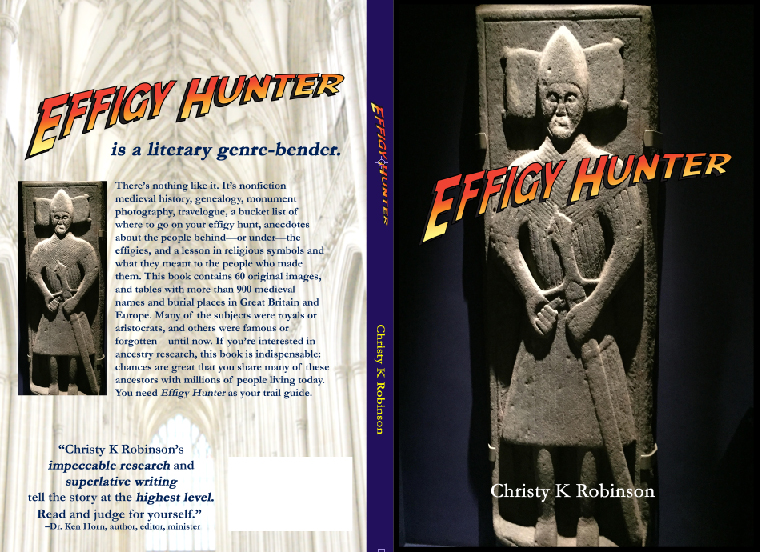
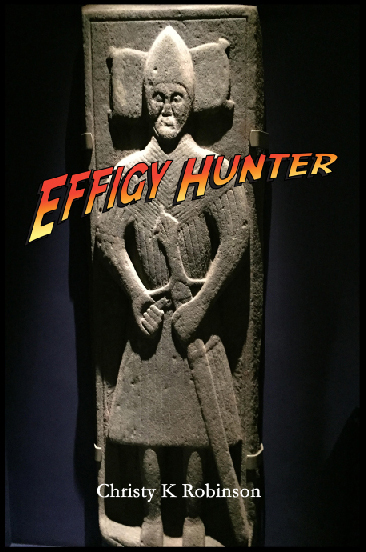
EFFIGY HUNTER, new book on your medieval ancestors

Screenshot of book cover design

Effigy Hunter is a literary genre-bender. 

There’s nothing like it. It’s nonfiction medieval history, genealogy, monument photography, travelogue, a bucket list of where to go on your effigy hunt, anecdotes about the people behind—or under—the effigies, and a lesson in religious symbols and what they meant to the people who made them. This book contains 60 original images, and tables with more than 900 medieval names and burial places in Great Britain and Europe. Many of the subjects were royals or aristocrats, and others were famous or forgotten—until now. If you’re interested in ancestry research, this book is indispensable: chances are great that you share many of these ancestors with millions of people living today.

You need Effigy Hunter as your trail guide.

Available beginning September 2015, EFFIGY HUNTER on Amazon

Thursday, August 6, 2015

EFFIGY HUNTER, new book in 2015

© 2015 Christy K Robinson 

As a writer, editor, blogger, and book author, I'd like to flatter myself that people visit my blogs to read my golden prose. [Insert angel choir here.] Blog stats tell a different story than what my ego would like: people find my photos in image searches and come to my stories. They download my photos and without so much as a bye-bye, they're gone, to post in their own pedigrees or blogs. That's why I've been keeping this project secret until now.

In September 2015, I'll release my latest book,
EFFIGY HUNTER

It will be available in paperback (I haven't yet decided about Kindle), with about 60 high-resolution grayscale images, and more importantly, tables of more than 900 names and burial places of your and my medieval ancestors, plus historical sketches about some of them--all in about 200 pages.

The chapters and their tables cover England (by county), Scotland, Ireland, Wales, France, Italy, Spain, Portugal, Germany, and a chapter on crusader and pilgrim burials.


This is the Foreword to the book:


            Is this book a travelogue? A bucket list of where to go if you’re an effigy hunter? An aid to genealogy research? A nonfiction history of human beings whose lives are mostly forgotten now? A lesson in religious symbols and what they meant to the people who made them? The fruit of decades of research and the desire to chart it so there could be a simple way to unravel and understand the mysteries of five hundred to twelve hundred years ago?
            Yes.
           Is this book morbid, scary, or depressing, listing (as it does) burial places for so many people who have gone before us?
            No.
            Some of the anecdotes are humorous, and when I was doing the research, I was surprised many times at the absurdities and coincidences I found.
            There are 60 images and more than 900 names in the charts of this book, and references to hundreds more in places like Westminster Abbey and St. Denis, which are royal mausoleums. I found the burial places in genealogy records, history books, guidebooks at the churches, online articles, and by personal visits to many of the places you’ll find in this book. I collected the images, most of which came from my camera, on several educational, vacation, and business trips to the UK and Europe. The historical information came from site visits, books (some of them digitized from 19th-century histories), and websites.
A few of the articles were edited from my research blog, Rooting for Ancestors, where readers have expressed their appreciation for the images and informal, conversational writing style, and for the subjects I’ve raised. Some of the subjects may be obscure, but those were the articles that received the most interested and informed comments.
“History is best understood by walking the ground where it happened,” said documentary filmmaker Ken Burns. “You feel the presence of what went on before. We go to these places because we're aware that the ghosts and echoes of an almost inexpressibly wise past summon us.”
I hope you’ll find this book entertaining and enlightening, and that it will inspire you to not only take a virtual tour through its pages, but save your shekels for your own effigy hunts. There are hundreds, maybe thousands, more effigies and burials to be discovered or identified. As extensive as my research is, it’s a fraction of what’s left to be hunted and photographed.
Remember, it’s not about the blank stare of the 700-year-old marble effigy—it’s the reminder of the person it represents. Go on, I dare you: learn who they were. And remember. 

Joan (Siwan) Plantagenet, 1191-1237, Lady of Wales,
consort of Llywelyn the Great, Prince of Wales.
She was buried at Llanfaes, but her empty tomb is at
Beaumaris parish church.
The English counties are listed in alphabetical order. If there is an anecdote, commentary, or image, it will accompany the chart.  


Name
Birth year
Death year
Burial place or church
Town
Country
Style of monument if known


UPDATE: EFFIGY HUNTER, in paperback, is now available for purchase at this highlighted link: Effigy Hunter, by Christy K Robinson.

 You can help spread the buzz by commenting below and sharing this article in Facebook, Twitter, Pinterest, LinkedIn, and other social media. In fact, here's a short URL for your convenience: bit.ly/1T8lROy

Saturday, February 7, 2015

Juliana Cockerel Eyre, 1444-1503

Hans Memling The Last Judgment
detail (circa 1433–1494)
Mystery solved!

© 2015 Christy K Robinson


Medieval and Tudor-era women, unless they're royal or aristocratic (and even then...), are often forgotten when it comes to a surname or history, or where they were buried. 

The Eyres/Ayers of Wiltshire were no exception. Generations of Eyres lived in the villages of Urchfont and Wedhampton, Wiltshire, only a mile apart. Urchfont has a lovely church, St. Michael and All Angels, but I can't find record of the Eyres being buried in it (though some of them must certainly lie under the floor slabs). I visited the church in 2006. 

Records on the Eyres go back to 1221, when Humphrey LeHeyr was born--a good 30 years after he supposedly accompanied Richard I the Lionheart on Crusade. (Seriously, people really need to look at some timelines before they write that stuff!) 

Urchfont and Wedhampton lie on the Salisbury Plain near Devizes, north of Sarum and Salisbury, and not far from the prehistoric sites of Woodhenge, Stonehenge, West Kennet Long Barrow, and Silbury Hill.

There was a church at Urchfont from 900AD, the time of King Alfred and his Queen Aelswith, but the present building began early in the reign of King Henry III, about 1220. The tower was built in the latter 1400s, within the lifetime of Juliana Cockerel Eyre.  

After Humphrey LeHeyr, we have this succession of descendants:
  • Galfridus LeHeyr, b. 1250 in Wiltshire
  • Galfridus LeHeyr, b. 1285 in Wiltshire
  • John le Eyre, b. 1325 in Wedhampton who married Eleanor Crooke, heiress of Urchfont
  • Simon Eyre, b. 1364 who may or may not be the same man who was Mayor of London and founded Leadenhall Market.
  • Thomas Eyre, b. 1399
  • William Eyre, b. 1444 in Wedhampton who married Juliana/Johana Cockerel, b. 1444.
  • John Eyre, b. 1478
St. Michael and All Angels church,
Urchfont, Wiltshire, UK.
Photo by Christy K Robinson

William and Juliana had two sons, one of whom is my ancestor, John Eyre. Juliana, as far as I know, was not nobly born or notorious for her words or deeds; she was a wife and mother from Wedhampton, Wiltshire.

The other son was nameless, and isn't mentioned in genealogy records, so I and probably many others assumed he died young, forgotten, with no heirs.

But I found the other son, and it explains why, of all the Eyres, only Juliana Cockerel Eyre was buried in Christchurch Priory, 49 miles due south, on the chalk-cliffs coast of England. Their other son was named William after his father, and he was a man of the Church. William was born in 1478, and he was firstborn.That sets up the questions for which we have no answer:
  • Why the firstborn son instead of the younger son? Usually, the firstborn would inherit a double portion of the parents' estate, and a subsequent son would enter the military or monastic life.
  • Was William a promising scholar who would benefit with a Church education? 
  • Was he gay (closeted, of course)  and not likely to produce an heir for the Eyre line? His brother John is the ancestor of countless thousands in UK and America.
  • Did William's father do something wrong and feel the need to sacrifice his firstborn son to monasticism of the Church, and be a link to prayers for the parents for a lifetime? When a child or young person, male or female, was dedicated to the Catholic Church, they usually came with a dowry or large gift to benefit the monastery or nunnery. The larger the gift, the larger the chance the child would be destined to be an administrator with power: an abbot or prior, an abbess or Mother Superior, or perhaps a bishop. 
When googling Eyre and Christchurch, attempting to discover the location, and even better, an image, of Juliana's tomb or slab, I saw a link to an archaeological/historical description of the fabric of Christchurch Priory. And there I found a William Eyre, sub-prior and then prior of the priory (a monastic community), at exactly the right time. During his tenure as prior, 1502-1520, William Eyre was responsible for the rebuilding program of the quire/choir section of the huge church. The former choir had been destroyed in 1420, when the central tower of the church fell down or was taken down. So the new Great Choir, where the monks performed their worship at the daily appointed times, was a welcome addition. This choir still stands today! 

The web page, transcribed from an old book, says  

In addition to the monuments already noted there are a good many floor slabs with incised inscriptions, originally filled in with black composition. The oldest of these are in Gothic capitals, and there is such a strong resemblance between a number of them in treatment and in the peculiar form of the inscription as to make it probable that they belong to one date, although commemorating persons of different periods. Several of them belong to priors of the house, others to lay persons. The best preserved inscriptions run thus:—
'Tumba dni Wilhelmi Eyer vicesimi qũrti prioris huius ecclesie qui obiit vio die mēsis decembris anno domini Milleno ccccc . . .o cuius anime propicietur deus. amen.'  ['Tomb of lord William Eyer formerly of this church, who had died the 21st day of December in the year 1520. . .o may God bless his soul. Amen.']

Close to Prior Eyre's gravestone is that of his mother: -
'Hic jacet Johaña Cokrell mater Wilhelmi Eyer prioris huius ecclesie cuius anime propicietur deus. amen.'  ['Here lies Johaña Cokrell the mother of Willelmi Eyer the prior of this church of which may God bless his soul. Amen.']

Because the book didn't provide a translation of the Latin, I translated William's inscription several times using Google Translate, which returned variants, which I averaged. Five-hundred-year-old vernacular Latin wording won't be much like a modern computer translation, nor classical Latin.

Juliana lived long enough to see her son elected prior, which must have made her extremely proud. Does her inscription "of which may God bless his soul" mean that Prior William desired her prayers for him, from her place in heaven? Or does it mean that once she went to heaven, her soul became male? That was the belief of some people at the time. 

I had already combed through the Christchurch Priory website to find their virtual tours, and found 360-degree still pictures of the Great Choir and the choir aisles (hallways around the outside of the choir). There are floor burial slabs in both north and south aisles. Juliana and her son the prior (who died 17 years after she did) would have been buried in the floor of one of those choir aisles.
Screenshot courtesy of
http://www.christchurchpriory.org/fabric-history/virtualtour.html

In medieval terms, it was a prime burial spot because your grave would be close to all masses said in the chancel, and close to any saint relics the church might have. If you gave property to the church, or your surviving family did, the prayers and masses said, and candles lit, might help your soul out of purgatory sooner. The monks or priests frequently saw your tomb, effigy, brass, or slab, and remembered to pray for your soul. 

"One thing have I desired of the Lord, which I will require; even that I may dwell in the house of the Lord all the days of my life, to behold the fair beauty of the Lord, and to visit his temple."

And look: here we are, 500 years later, thinking about Juliana Cockerel Eyre. If you're her descendant, why not light a candle wherever you are, and say a prayer.

"I AM the resurrection and the life, saith the Lord: he that believeth in me, though he were dead, yet shall he live: and whosoever liveth and believeth in me, shall never die." 


The Christchurch nave, looking east to the stone choir screen
behind which lies the Great Choir built by Prior William Eyre.
He died in 1520, nineteen years before the Dissolution.
Henry VIII had the monastery torn down, but the church was
allowed to stand as a parish church. It's larger than 20 of
England's cathedrals. One might suspect that the people
of Christchurch paid a very large ransom to keep their church
from destruction.


Seventy-five years later, the Eyre descendants placed alabaster memorials high on the south walls of St. Thomas Beckett Church, almost in the shadow of Salisbury Cathedral. By this time, they were prosperous merchants, Members of Parliament, and Salisbury mayors in the Elizabethan era, and they may have been Puritan, since the memorial inscriptions say they “hated idolatry.” Several generations after that, a branch moved to the oh-so-Puritan Massachusetts Bay Colony and settled near Salem (where a descendant, Mary Ayer Parker, was hanged as a witch in 1692), then moved south to New Jersey. From the Reformation in the early 16th century, they were Protestant all the way: Anglican, Puritan, Baptist, and Seventh Day Baptist.

If you enjoy life sketches, anecdotes, and historical details like these, you can find them in the book Effigy Hunter, by Christy K Robinson. It's available in print from Barnes and Noble and Amazon.


Christy K Robinson is the author of five-star nonfiction and fiction historical books, as well as author of Rooting for Ancestors and William and Mary Barrett Dyer websites. You will find her books at http://bit.ly/RobinsonAuthor.


·          We Shall Be Changed (2010)
·          Mary Dyer Illuminated (2013)
·          Mary Dyer: For Such a Time as This (2014)
·          The Dyers of London, Boston, & Newport (2014)
·          Effigy Hunter (2015)
·          Anne Marbury Hutchinson: American Founding Mother (2018)