EFFIGIES and MARKERS

Monday, October 2, 2017

How I research my history and genealogy books

Saturday, 30 September 2017


Diana Milne talks to Christy K Robinson - author, editor, organist and jam maker extraordinaire!

© Diana Milne 2017 © Christy K Robinson 2017  
I am sure that you are tired of being asked the usual questions that would be interviewers ask authors, so hopefully this interview is an interview with a difference and I have come up with some unusual questions!

Christy K Robinson is author of this website and these books. Click the book titles to find them in paperback and Kindle.


·          We Shall Be Changed (2010)
·          Mary Dyer Illuminated (2013)
·          Mary Dyer: For Such a Time as This (2014)
·          The Dyers of London, Boston, & Newport (2014)
·          Effigy Hunter (2015)
·          Anne Marbury Hutchinson: American Founding Mother (2018)


 First things first. I am sure there is a question that you have always longed to be asked. Now is the chance. Ask your own question and answer it!
“Christy, we’d love to employ you as one of our editors here at [magazine or book publishing company in California] at a decent salary, and offer you three weeks’ paid vacation every year in UK or Europe. What do you say?”  
“Heck, yeah! I can start last week.”
And then I could still research and write, teach piano to three or four kids a week, grow some veggies, and play keyboards for churches, but for fun, not scratching out a living.
 

If your latest book (Effigy Hunter) was adapted into a TV show or a film, who would you like to play the lead role?
I have actually mapped out Effigy Hunter as a PBS show, with a reporter (not me) doing stand-up shots in various cathedrals or ruined abbeys around the UK and Europe. I need to find commercial sponsors like travel agencies and airlines, a producer, video crew, etc., and I’ll happily write the scripts.

 As for my fiction and non-fiction set in the 17th century, I’d love to see a multi-year TV series between England and New England about the first founders—not of the United States in 1770s, but of the founders in the 1630s. Their issues still resonate today. Lead role? This world needs more Colin Firths in it. 

What made you choose this genre?
First, I’ve been a history lover since I was in primary grades, and then I subscribed to archaeology magazines for years. I helped my chronically ill mother with family genealogy in the 70s, and did a lot of it on my own after she passed. I created a six-by-nine-foot pedigree chart that hangs on my wall, and I stuck laser-print headshots of every ancestor I could find, next to their name. Like millions of other people, I can trace my lines back to some important people, and books had photos of their effigies, so they got copied and stuck onto the chart. Then I finally earned enough mad money to book my trips to UK and Europe, and after much research and not a few hunches, I became an Effigy Hunter myself. I passed on most of the touristy sites, but looked up old abbeys, country churches, and cathedrals. In my professional life, I’ve been a book and magazine editor since my university degree, so nonfiction and a topical format, rather than a character-driven plot, is my forte.  Even my novels are as close to truth as I can make them.
It’s difficult to assign a genre to Effigy Hunter, as it’s a locator and description of nearly a thousand effigies in the UK and Europe, plus stories about some of the people memorialized in stone. It’s travelogue, history, genealogy, photos, and a bit of a romp, as one reviewer put it. A search of the internet, Amazon, and various booksellers reveals that this is a unique book—nothing like it. 

How do you get ideas for plots and characters?
If I’m working on a historical novel, I only need for characters to be born during my timeline! And in my non-fiction, I only require that they be dead (so there’s a burial place to write about). 

If, as a one off, (and you could guarantee publication!) you could write anything you wanted, is there another genre you would love to work with and do you already have a budding plot line in mind?
Yes, in research for my biographical novels on Mary Dyer, I found that one of my secondary characters had a sister who was a transvestite. She was baptized a female, then disappeared from records (except for her portrait as a young man), then was buried as a woman with her same birth name, not a married name. She came from a very famous family in the mid-17th century, and I think they supported her and allowed her to live as a man. I’d like to make her a heroine/hero against child-traffickers, which was as terrible then as it is now. I do have two villains in mind, who were Puritan preachers as well as scoundrels. She never had children, but her siblings had descendants, one of whom is currently a member of the House of Lords. I’ve written to him several times, but no answer. I can’t afford time off my self-employment, or the travel expense, to go back to UK and sort out details. 

Was becoming a writer a conscious decision or something that you drifted into (or even something so compelling that it could not be denied?) How old were you when you first started to write seriously.
Conscious. By nine years old, I’d turn in school reports as if they were articles in a newspaper. No one taught me that. I just did it. Then the teacher published one of them on the purple mimeograph machine in the school office, and I knew I had a future in writing. I was a teen reporter for Arizona’s largest newspapers during my last two years of high school, and hoped for a career in journalism, either newspaper or magazines. My mother was my best writing coach, and she’d have me study an encyclopedia article, then rewrite it using a thesaurus. The best advice from a professor? Write to a specific audience, and even better, a face. That helped develop my “voice” as a writer. Editing and writing newsletters, magazines, websites, and other short-form was easy and fun, but writing fiction came very late. I have a vivid imagination, but I dread just making up a story. 

Marmite? Love it or hate it?
Neither love nor hate. It’s OK. The real question is: Christy’s homemade fruit jams—merely delicious, or crack?
My kitten plays Godzilla in a recent batch of jams.
https://www.facebook.com/IB-Jammin-985968984798333/

Do you have any rituals and routines when writing? Your favourite cup for example or ‘that’ piece of music...??
Nope. No sound track. No favorite pair of jammies. No alcohol. But it’s almost impossible to write unless it’s after 9pm. I can research any time, but writing won’t happen earlier than that. 

I promise I won’t tell them the answer to this, but when you are writing, who is more important, your family or your characters?
I promise not to answer, except that I am never-married and childless. 

Other than writing full time, what would be your dream job?
Historical research, digging deep in libraries and archives. *shivers* 

Coffee or tea?
Depends on the country. Tea in the UK because your coffee is too strong, and your tea is smooth and mellow (Yorkshire Gold for me). Coffee in the US. My parents were from Minnesota, and Minnesotans are born with coffee in their circulatory system, so... 

How much of your work is planned before you start? Do you have a full draft or let it find its way?
I have a rough layout in a Word document, and a detailed, multi-column timeline in Excel, and expand from there. I’ve been a magazine and newsletter editor since 1982, so I project several months ahead of today, and I’m always thinking of what will interest the reader: anecdotes that fit the facts, images, recent news that correlates to historical events, etc.
 

If you had free choice over the font your book is printed in, what font/fonts would you choose?
Comic Sans. (Kidding! I hate Comic Sans. May the fleas of a thousand camels infest the armpits of the designer of Comic Sans.) Georgia is very readable. My editing clients lately have preferred Calibri in their manuscripts, but it’s dangerously similar to Comic Sans. 

Imagine that you could get hold of any original source document. What would it be?
The personal papers of the (real) characters of my biographical novels. I have high-resolution images of four of their business letters, but I want their notes, personal letters, a journal, the family Bible, etc. I don’t know if they exist, but I suspect there might be some detailed reports written by Mary Dyer’s husband, to Spymaster Thurloe in the 1650s, that would be in the British Library. Online, and transcribed, I believe I have found a letter from Oliver Cromwell to William Dyer, though Dyer’s name is not attached—the situation is unique to him. 

Have any of your characters ever shocked you and gone off on their own adventure leaving you scratching your head??? If so how did you cope with that!?
Nope. My biographical novels were as close to the actual events and timelines as I could make them. But digging up stories for nonfiction Effigy Hunter was fun because I had to wonder: what grave sins did these men commit, that they had to make a pilgrimage to the Holy Land and pay for some big ol’ churches to be built to get themselves busted out of purgatory? 

How much research do you do and do you ever go on research trips?
C’mon, I’m still researching my novels published in 2013 and 2014! (For my blogs, I tell myself.) As for research trips, yes, I’ve been to UK five times, and they were all about research—because research is fun. I took hundreds of photos on those trips that became valuable resources when I finally got around to writing Effigy Hunter. I put together a book trailer with those photos. https://youtu.be/LHGCVmgDe9k 
Also, I travelled to Boston and Newport in New England for concentrated research. I was gratified to find that my book-learnin’ and Google Maps street views were true to life, according to natives of the areas. I live in Phoenix, Arizona, thousands of miles away. 

Fiction authors have to contend with real characters invading our stories. Are there any ‘real’ characters you have been tempted to prematurely kill off or ignore because you just don’t like them or they spoil the plot?
Well, there was one fellow integral to the story that I tried to research, but he was so odious, even to his descendants, that only one man in 400 years wrote a very apologetic biography of him. He was still alive at the end of my novel because he killed my heroine.  However, I did carefully research the others, even the villains, so they wouldn’t be flat cartoons, but three-dimensional human beings. And of course, in the nonfiction Effigy Hunter, they all died. Every one. Not one lived to tell the tales. 

Do you find that the lines between fact and fiction sometimes become blurred?
Lines are totally blurred in genealogy websites. Enthusiastic hobbyists will post and propagate all manner of mistakes and suppositions. However, I trust peer-reviewed journals, modern history books (but not Victorian ones), and census or military records. In some cases, I found information and made connections that no one in 400 years had thought of—but they happened. I wrote them into my books, and now, several years later, the fact/fiction border is blurry to me. 

What do you enjoy reading for pleasure?
I’m such a nerd. Straight history far more than historical fiction. Biography. Science and political news. 

What drink would you recommend drinking whilst reading your latest book?
Whatever Indiana Jones would drink. I mean, Effigy Hunter is adventure travel. 

Last but not least... favourite author?
I could give you my “least favorite author” if you hadn’t typed that ellipsis in there. But for a favorite, I think I’m going to go with the apostle, St. John the Beloved. (That handily avoids playing faves with the authors I’m privileged to hang out with.) I learned that people cannot be told enough times that they are loved. Loved by humans, loved by pets, loved by God, or loved by the “Universe.” They need to hear it. And John the apostle said it a lot. By the way, Diana, I love you and your humor. 

More about Christy K Robinson, including her history blogs, at http://ChristyKRobinson.com

https://thereview2014.blogspot.com/2017/09/diana-talks-to-christy-k-robinson.html?showComment=1506905291324#c5005414229903380771 

Saturday, September 2, 2017

Halloween special, Christmas special, vacation-planning special


Effigy Hunter is a book about the LIVES of your medieval ancestors (and where to find their effigies and burial places). It's a five-star book for you and for your friends and family who enjoy history and tracking down famous ancestors. It's adventure travel! 

Amazon US http://bit.ly/EffigyHunter
Amazon UK bit.ly/EffigyHunterUK
CreateSpace https://www.createspace.com/5656517
Barnes & Noble http://bit.ly/1YEdgro
Book Information: http://rootingforancestors.blogspot.com/p/blog-page.html 


YES, you may share this post any time you want to. Copy the URL into a Facebook status or Tweet, or use the little sharing buttons below this post. Thank you for sharing!

Tuesday, July 4, 2017

Revolutionary War ancestors


Revolutionary War ancestors, who are 5th great-grandfathers, or 7 generations removed.

Happy Independence Day, brought to you by men and women who paid for our liberties with blood and all the horrors of war. These are some of my Revolutionary War ancestors. I'm trying to add women to the lists. Though they obviously held no rank, they lost husbands, sons, and "collateral damage" young children. They moved away from homes and farms to escape certain death, and sometimes met death anyway. They supported large families of children by themselves, and were probably significant suppliers of woven cloth and food for soldiers.

The research is ongoing, and I add new bits and pieces to the blog article every year.

Paternal ancestors:
Capt. Jared Robinson, 1740-1826, 6th Regiment, Connecticut Line. He served in the French and Indian War, 1759; Continental Army 1775 and 1776; commissioned as a Commander of a ship 1779 and 1781. He and his wife, Mary Thompson, had at least 11 children, born in several locations in Connecticut, so she may have been moving the children around for safety.
Corp. Joseph Howe, 1746-1807, Connecticut 1st Regiment, served 8-month levies until 1782. 
Lt. Asa Stevens, 1734-1778, died in Massacre of Wyoming, Pennsylvania. Hacked to death and scalped by indigenous warriors allied to British troops, who paid bounties for scalps. For a post on Asa's Patriot wife, Sarah Adams Stevens, see this article
Daniel Downing, 1739-1813, Connecticut, Capt. Branch’s Company, Jan. 10, 1778. He was related by marriage to Sarah Adams Stevens, above. He was a private in the French-Indian War in 1759. He also served between 1775 and 1782 with the 3rd  and the 1st New Hampshire Regiment, which saw action at the Battle of Bunker Hill, the Battles of Saratoga, and the Battle of Newtown. In addition, the regiment participated in or was present at the Siege of Boston, the Invasion of CanadaValley Forge, and Sullivan's Expedition.
Pvt. James Hamner, 1725-1792, Mecklenburg, Virginia. 
Pvt. Hugh McDonald, 1757-1828, of South Carolina. Enlisted 1775, 1778, 1780. Fought British in several actions including Sullivan's Island; taken POW in 1779 for 332 days, during which he had smallpox on the prison ship. Wife Rebecca Rogers visited him (probably nursed him) when he was so ill that he was sent ashore. He was released in Fairfield, Virginia, and Rebecca was there with him, 500 miles from home. After his recovery, he volunteered again, as a foot soldier. 
Sgt. William Page, a doctor, served in Amherst, Virginia, beginning in 1777.   
Pvt. John McFatridge, enlisted Feb. 3, 1776. 
Thomas Graham's (1735-1810) name appears on a cenotaph in Shelbyville, Kentucky, with other officers and soldiers of the Revolutionary War.
Pvt. John Grist, 1734-1882, of Connecticut, served in Schenectady, New York, in 1778. 
Pvt. Henry Hamner, 1759-1844 Mecklenburg, Virginia/Kentucky.  In 1778, he guarded an ammunition magazine on the Roanoke River.
Pvt. Charles Carter, 1743-1781, Virginia. Died in service to the Continental Army. 
Pvt. Martin Carter, 1763-1842, Mercer County, Kentucky. He was only 15 years old when he enlisted in the Virginia Militia. 


Dr. James Osborne, b. 1748 in Orange, New York, died 1820 Tunkhannock, Penn. He was a surgeon in the Continental Army.   
Pvt. James Trapp, 1760-1832, Ulster, New York, Fourth Regiment -- (Hardenburgh's) Rank Enlisted Men. The regiment would see action in the New York Campaign, Battle of Saratoga, Battle of Monmouth and the Sullivan Expedition.  
Corp. James Westervelt (Westerfield), 1755-1826, New York. (His father, Jacobus Westervelt, age 42, was killed and scalped in the 1780 Westervelt Massacre in Kentucky, moving four families away from British troops. The Dutch-American families were fleeing British occupation, and were slain by English-allied indigenous people on a wilderness road. The husband, Jacobus, only 42, was hacked to death and scalped (the English paid bounties on scalps). One of his sons died. The wife, Mary Demarest Westervelt, hid with three daughters in a sinkhole, and another daughter, Deborah, and niece Polly were abducted to Canada. The natives stole their horses and plundered their goods. When Mary recovered, she went in search of her daughter, but her horse was shot from under her and she was also abducted. She was moved to Fort Detroit, where an English officer released her. The daughter and niece eventually found their own way home from Quebec. Her son James, my 4th-great-grandfather, was not in the massacre because he was away fighting with the Continental Army.)

The British Army paid a bounty on the scalps of the men of the American Continental Army. Some of my ancestors were killed and scalped because of this barbarian practice.

Maternal ancestors:
Capt. James McClure, 1739-1798, 2nd Artillery Regiment, Virginia

Society of the Cincinnati,
Capt. Edward Slocum, founding member

Capt. Edward Slocum, 1748-1822, 1st Continental Battalion, Rhode Island.
Lieutenant, 3rd Rhode Island Regiment, June 1775.
Taken prisoner at Quebec, December 31, 1775, released in 1776.
1st Lieutenant in Continental Army, January 1, 1777.
Captain in Continental Army, May 26, 1777.
Charter member of the Society of the Cincinnati as is shown by the following writing to which his name was subscribed :— "Cantonment of American Army on Hudson's River, May 10th, 1783.   
Capt. Jonathan Proctor II, 1739-1808. Already a veteran of the French and Indian War of the 1750s when he was just 20 years old, he now joined the Continental Army and was promoted to Captain. 
Corp. John Felton, 1741-1820, Served, 1777, as a corporal in Capt. James Lewis' company, Col. Daniel Moore's New Hampshire regiment. 
Ensign Caleb Fowler, 1755-1822, Connecticut.  

 
Pvt. Joseph Scott, 1745-1800, New York. He was a private serving in New York in 1777, 1779, and taken prisoner by British--he was carried to Canada and remained a prisoner of war between May and November 28, 1780.
Corp. Jesse Rowley, 1752-1804, Connecticut.   
James Wallace, 1731-1819, served in New Hampshire's Bellow's Regiment of Militia. 
          Sgt. William Page, 1743-1815, member of Amherst County militia, Virginia


*****
Christy K Robinson is author of these books:
Mary Dyer Illuminated Vol. 1 (2013)  
Effigy Hunter (2015)  

And of these sites:  
Discovering Love  (inspiration and service)
Rooting for Ancestors  (history and genealogy)
William and Mary Barrett Dyer (17th century culture and history of England and New England)
Editornado [ed•i•tohr•NAY•doh] (Words. Communications. Book reviews. Cartoons.)

Tuesday, August 9, 2016

Surviving a deadly forest fire in 1910 Minnesota

1910: Edith Hall before
she married John Stone.
© 2016 Christy K Robinson

While casually googling my maternal great-grandparents, I discovered a 1912 legal suit they brought against Canadian Northern Railway for a locomotive-caused forest fire that destroyed part of their northern Minnesota properties in 1910. They lived on homesteads near Williams, Minnesota, and they were clearing the land for cultivation, selling the timber to the sawmill at Rainy River, or to the related industries like box-makers, toothpick-makers, and paper mills.

1910: John Stone as a
single man.
September-October 1910, the time of the fire, was described by the rail company as very dry and windy, with numerous grass and forest fires that summer, so Canadian Northern didn't want the blame for a spontaneous combustion that flared up on the rail embankment, seven minutes after the coal-fired engine passed.   

The spring and summer of that year were extremely dry, and hotter than any year they could remember. There was a drought that made forests and prairies, after abundant winter snows, into fuel ready for any spark of locomotive cinders, lightning, or even glass or metal lying in the grass. The foresters stripped the branches off limbs and trunks and littered the ground with them, creating even more quick, hot fuel for a firestorm. (The heat and drought, combined with poor agricultural practices, also made a dust bowl of the prairies, that was a precursor of the more-famous dust bowl of the 1930s.) A great fire in Washington-Idaho-Montana had also raged that summer.
 
Canadian Northern locomotive and coal car from 1910.

In the Minnesota inferno, there may have been as many as four fires that merged into a single conflagration that burned for miles and destroyed 400,000 acres. Between 29 and 42 people were killed. 

 My great-grandparents and their neighbors won the suit, as the court ruled that the locomotive cinder or spark was the cause. Edith was able to prove that her lost timber, still standing as live forest until the fire, was more valuable than cut scrubby stuff that was laying around to be carted away or burned as fuel. She got more money. John Stone was awarded $265 and Edith Hall was awarded $525. The rail company appealed, but the judge upheld the original ruling. 

Take that, Canucks, eh? That's $790 (1912 value) you'll never see again! In 2016 dollars, the value would be $18,842.

In addition to the awards, my great-grands got court costs. They were still single at the time of the fire, but they married on November 10, 1910, in Winnepeg, Manitoba, and their firstborn, my grandmother, was born in 1914. From what I've seen in photos, they lived a frugal, homestead sort of life, with summer gardens, lake fish and forest meat, and I can't imagine what they did with the settlement money.

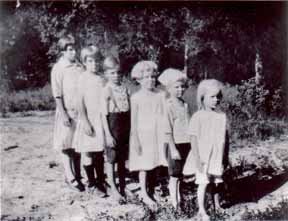
The Stones had four single births and one twin birth, and their children, 1925-ish, posed for a photo in a stairstep formation.  My second cousin, a granddaughter of Helen, says, "I recall a story about such fires that happened up there, though it had to be after John and Edith married. The story was of surviving such a fire by soaking mattresses in the creek and then getting in the creek and under the wet mattresses as the fire passed by. I don't have any facts, though, just the story." I heard the same story on my branch of the family. That may have been sometime between 1918 and 1928, as our grandmothers were old enough to remember the fire and how they survived the burnover.
1924-25: Lois (my grandmother), Helen, John, Ruby,
and the twins Russell and Ruth.


I read on Wikipedia that the Spooner-Baudette Fire of 1910, which burned Williams where the Halls and Stones lived, was the third-worst fire in Minnesota history, and "...For this reason, the 1910 Baudette Burn is considered one of the most significant wildfires in Minnesota history. As a direct result of this catastrophe, funds were approved by the legislature to establish the Minnesota Forestry Service (later the DNR) with its system of forest rangers and forestry districts." How fascinating that Edith's and John's grandson, my uncle Lloyd, was a DNR ranger for his entire career, in the Minnesota-Canada border region.
1930: My great-grandparents, Edith Mae Hall (b. 1891) and
John Stone (b. 1880). Notice the puff of smoke in the distance!
The great-grandparents eventually moved to International Falls, Minnesota, where there was a paper mill, and that's where they raised their children in the 1920s and saw the first of their grandchildren born in the 1930s. John died in 1938, and Edith was killed at age 55 by a train-versus-car accident in icy Michigan in 1946.


Christy K Robinson is the author of five-star nonfiction and fiction historical books, as well as author of Rooting for Ancestors and William and Mary Barrett Dyer websites. You will find her books at http://bit.ly/RobinsonAuthor.


·          We Shall Be Changed (2010)
·          Mary Dyer Illuminated (2013)
·          Mary Dyer: For Such a Time as This (2014)
·          The Dyers of London, Boston, & Newport (2014)
·          Effigy Hunter (2015)
·          Anne Marbury Hutchinson: American Founding Mother (2018)


Monday, February 8, 2016

EFFIGY HUNTER readers are saying...


Available at
Amazon US http://bit.ly/EffigyHunter 

By on October 30, 2015
Millions died during the Black Death, and the plague was no respecter of class. So many lives were lost that Europe’s nobility had to seek spouses among the commoners. Royal blood seeped outward, and as a result, most Americans with English ancestry are descended from kings, including me. So is Christy Robinson, and this masterful storyteller has turned her quest for royal ancestors’ resting places into "Effigy Hunter."

Is this intriguing book a history, genealogy, or personal memoir? All that, and more. Ms. Robinson’s meticulous charts provide readers with locations and descriptions of tombs and effigies, interspersed with unique photographs and lively travel anecdotes. Whether you wish you could make the trip to England to visit your royal ancestors’ graves, or have lunch at the holy isle of Lindisfarne with an engaging guide, the informative and entertaining "Effigy Hunter" is for you.

**************** 
By on September 28, 2015
Genealogy enthusiast and historical author Christy K Robinson’s family history searches have taken her into the great cathedrals and obscure country churches in which her own ancestors—and those of the millions of other people sharing their genes—and other notables were either interred or commemorated. Her latest book is a treasure trove of information about the burial styles of her numerous subjects, primarily royalty and aristocracy of Britain and Europe during the Dark Ages and Medieval times. Not only does she analyse specific monuments and their symbolic elements, she describes the effects of civil wars and religious disputes on the physical contents of churches and examines discrepancies between burial records and popular legend.

A valuable reference for historians and genealogists, Effigy Hunter is equally a travelogue and travel memoir. Through anecdote, illustrations, and photographs, Robinson shares her extensive travels through England and other countries. Region-by-region sections contain charts of essential information on the location and dates of effigies and memorials, making this a useful field guide for those wishing to visit sites in person. As entertaining as it is informative!
**************** 
History / Genealogy / Travelogue indeed! A fascinating genre-bender!
S. Ling on September 26, 2015
This review is from: Effigy Hunter (Paperback)

I received this book from the author as an advanced reader not really knowing what to expect, but I was delightfully captivated!

I love history for many reasons. Connecting with a past that is far removed from our present is an adventure -- learning about the movers and shakers of the day, what motivated them, and how they shaped the world, all of which is a good study for modern people; but perhaps what is most interesting to me about history above all things is connecting with the day-to-day lives of ordinary people who lived and breathed, who had hopes and dreams for life, and who did the best they could with the life they were given. Christy Robinson, in her forward, states about her book that it is a "history of human beings whose lives are mostly forgotten." She uses the effigies of long-dead people to try to breathe some life into the people behind the stone, saying "it's not about the blank stare of the 700-year-old marble effigy -- it's the reminder of the person it represents." In her search for each effigy, she, like others who go in search of ancestors, appreciated the connection with these people whose effigies grace the many churches across Europe, taking in the notion that the people whose effigies now stand cold and dark in those places actually stood in those same places at some point in their lives. The effigies provide a way to wonder about the lives of the people, not just wonder at their tombs.

After a bit of introduction, the book follows a trail of effigies regionally throughout mostly Great Britain, but also onto Continental Europe. Information is given about the effigies themselves, the detailed information about their locations and condition, but vignettes of certain individuals make the reading very easy and enjoyable. It's part travelogue/part reference book in a way I have never encountered before. Robinson has a very easy and casual writing style, easily accessible by the casual reader and more serious history student alike.

I would recommend this book to people interested in history and genealogy as well as anyone planning trips involving these regions to do a similar search of their own. A lot of time and care was put into the writing of this book, and it is a worthwhile companion for any traveler.

**************** 
By on September 26, 2015
Author Christy Robinson has a unique set of talents and interests. In this book, Effigy Hunter, her uniqueness has never been more evident. The narrative portions of the book are fascinating as travelogue. The charts that map the locations of important effigies are informative and meticulous works of original research.

I was fascinated with the book on two counts—as a historian and as a genealogist. This book is loaded with my ancestors (ancestors that are common—and, thus, of interest—to multitudes) and many other historically significant individuals. One need not have ancestors in the book to be captivated by its compelling narratives related to travel, biography and history.
This book defies genre. It is unique. It is interesting. It is academically valuable. You will profit from reading Effigy Hunter. I did.

**************** 
By Mr. M. Williamson on September 27, 2015
Format: Paperback
As someone who loves history and heritage I was naturally intrigued by Christy K Robinson's latest work: 'Effigy Hunter'; I wasn't too sure what to expect, a very similar feeling to grasping that ancient iron church door handle and pushing open the heavy oak door to reveal hidden treasures in the hushed gloom...

What I did find in Effigy Hunter was an impeccably well-researched read, written in an easily-accessible manner; Christy's adventures in tracking down ancestral memorials in forgotten corners of churches, big and small, throughout the UK and further afield are a pleasure to read and knit together to form a fascinating picture of her past.

****************
By on September 29, 2015
Not really sure how to describe this book! Are you fascinated with medieval history? Do you have an interest in genealogy? Do you look for a burial place in hopes of finding an ancestor or person from history? Are you curious about why people were buried they way they were, or where they are? Do you have an interest in the intricate symbolism in churches and tombs? If you answered yes to any of these questions, then this book is for you! Christy K. Robinson tells us about all these things through personal experience and impeccable research. I found I couldn't put it down. Easy to read, with tables of names, dates, and specific places that are very easy to follow. My favorite part of the book would have to be chapter 3, which describes the parts of a medieval church. The stories of who founded these churches and who are buried there are quite interesting. The intricate details of tombs and how they change through the centuries are also included. We get glimpses into these people's lives which makes this book all the more interesting. I guess if I had to describe this book it would be "The book you didn't know you needed, but you do!" A must for medieval lovers.

****************
By on October 1, 2015
This is an excellent guide for anyone searching for resting places of their ancestors among the churches of England. Set out county by county, it is a friendly book, easy to read and very informative. Far from just a list of places and people, Ms Robinson has little stories to tell about many of the people whose effigies she has successfully hunted. An invaluable resource for anyone undertaking family research, or just those intrigued by the names and stories behind the crumbling stone images, brass plaques and magnificent tombs.

**************** 
By on October 7, 2015
A wonderful book for those interested in history and genealogy that takes you through graveyards, churches, abbeys, and anywhere else where many historical well-known people are buried. It's filled with information, photographs, and lovely descriptions that the reader can enjoy while traveling along with the author in her search for the burial spots of her ancestors and many others. I loved the description of the medieval church, and also of the crusaders. It is focused primarily on England, but also includes burial spots of many in Europe, including France, Hungary, and Italy.

For travelers, as well as those of the armchair variety, it is a fabulous book to enjoy. I loved it.

**************** 
By on October 17, 2015
What an adventure! #EffigyHunter breaks the mold; it is travel writing, history, genealogy, yet it takes the reader to the United Kingdom, Paris, and other places in Europe giving new insights to those places while invoking the experienced traveler of good memories. Even the historian will learn nuggets of new historical information. The traveler will be along for the ride in this conversational romp through the United Kingdom and other points in Europe. The royalty depicted left millions of us as descendants. It's a miracle through centuries of sometimes-violent history that there are this many medieval effigies left. Try this book! You'll have fun and learn at the same time.

**************** 
By on October 11, 2015
I wasn't exactly sure what to expect when I began reading Effigy Hunter, as it is a genre bender. However, I have found it to be strangely fascinating. I am impressed with the depth of research and detail that has been put into this book. It brings to life real people who are usually only remembered as epitaphs. I particularly appreciate the logic presented regarding burial places of individuals. I would recommend this book to anyone who is interested in medieval history/genealogy as I am.

**************** 
By on December 13, 2015
Effigy Hunter is a fine book for anyone looking to go to England to see historic sites, specifically the monuments to many of our ancestors and many impressive grave sites. With 60 cool pictures in the book, I highly recommend it to those that like to have a reference library of our British noble or royal ancestors. I'm glad I bought it — The price is certainly nice.

**************** 
By on November 7, 2015
I can't tell you enough how fascinating this book is! Its like Rick Steves meets Indiana Jones! It's engaging, historical and utterly relevant information is a traveler's absolute "must have" if you're an individual researching your family tree or even just hitting the road less traveled by tourists. Even if you're an armchair or virtual traveler, don't leave this book behind as you go traipsing back in time, exploring who you are and where you came from!