EFFIGIES and MARKERS

Thursday, August 6, 2015

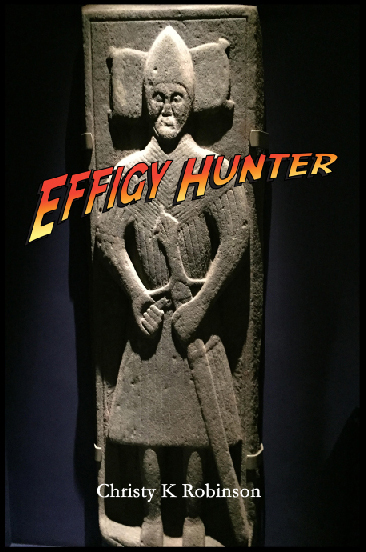
EFFIGY HUNTER, new book in 2015

© 2015 Christy K Robinson 

As a writer, editor, blogger, and book author, I'd like to flatter myself that people visit my blogs to read my golden prose. [Insert angel choir here.] Blog stats tell a different story than what my ego would like: people find my photos in image searches and come to my stories. They download my photos and without so much as a bye-bye, they're gone, to post in their own pedigrees or blogs. That's why I've been keeping this project secret until now.

In September 2015, I'll release my latest book,
EFFIGY HUNTER

It will be available in paperback (I haven't yet decided about Kindle), with about 60 high-resolution grayscale images, and more importantly, tables of more than 900 names and burial places of your and my medieval ancestors, plus historical sketches about some of them--all in about 200 pages.

The chapters and their tables cover England (by county), Scotland, Ireland, Wales, France, Italy, Spain, Portugal, Germany, and a chapter on crusader and pilgrim burials.


This is the Foreword to the book:


            Is this book a travelogue? A bucket list of where to go if you’re an effigy hunter? An aid to genealogy research? A nonfiction history of human beings whose lives are mostly forgotten now? A lesson in religious symbols and what they meant to the people who made them? The fruit of decades of research and the desire to chart it so there could be a simple way to unravel and understand the mysteries of five hundred to twelve hundred years ago?
            Yes.
           Is this book morbid, scary, or depressing, listing (as it does) burial places for so many people who have gone before us?
            No.
            Some of the anecdotes are humorous, and when I was doing the research, I was surprised many times at the absurdities and coincidences I found.
            There are 60 images and more than 900 names in the charts of this book, and references to hundreds more in places like Westminster Abbey and St. Denis, which are royal mausoleums. I found the burial places in genealogy records, history books, guidebooks at the churches, online articles, and by personal visits to many of the places you’ll find in this book. I collected the images, most of which came from my camera, on several educational, vacation, and business trips to the UK and Europe. The historical information came from site visits, books (some of them digitized from 19th-century histories), and websites.
A few of the articles were edited from my research blog, Rooting for Ancestors, where readers have expressed their appreciation for the images and informal, conversational writing style, and for the subjects I’ve raised. Some of the subjects may be obscure, but those were the articles that received the most interested and informed comments.
“History is best understood by walking the ground where it happened,” said documentary filmmaker Ken Burns. “You feel the presence of what went on before. We go to these places because we're aware that the ghosts and echoes of an almost inexpressibly wise past summon us.”
I hope you’ll find this book entertaining and enlightening, and that it will inspire you to not only take a virtual tour through its pages, but save your shekels for your own effigy hunts. There are hundreds, maybe thousands, more effigies and burials to be discovered or identified. As extensive as my research is, it’s a fraction of what’s left to be hunted and photographed.
Remember, it’s not about the blank stare of the 700-year-old marble effigy—it’s the reminder of the person it represents. Go on, I dare you: learn who they were. And remember. 

Joan (Siwan) Plantagenet, 1191-1237, Lady of Wales,
consort of Llywelyn the Great, Prince of Wales.
She was buried at Llanfaes, but her empty tomb is at
Beaumaris parish church.
The English counties are listed in alphabetical order. If there is an anecdote, commentary, or image, it will accompany the chart.  


Name
Birth year
Death year
Burial place or church
Town
Country
Style of monument if known


UPDATE: EFFIGY HUNTER, in paperback, is now available for purchase at this highlighted link: Effigy Hunter, by Christy K Robinson.

 You can help spread the buzz by commenting below and sharing this article in Facebook, Twitter, Pinterest, LinkedIn, and other social media. In fact, here's a short URL for your convenience: bit.ly/1T8lROy

Saturday, February 7, 2015

Juliana Cockerel Eyre, 1444-1503

Hans Memling The Last Judgment
detail (circa 1433–1494)
Mystery solved!

© 2015 Christy K Robinson


Medieval and Tudor-era women, unless they're royal or aristocratic (and even then...), are often forgotten when it comes to a surname or history, or where they were buried. 

The Eyres/Ayers of Wiltshire were no exception. Generations of Eyres lived in the villages of Urchfont and Wedhampton, Wiltshire, only a mile apart. Urchfont has a lovely church, St. Michael and All Angels, but I can't find record of the Eyres being buried in it (though some of them must certainly lie under the floor slabs). I visited the church in 2006. 

Records on the Eyres go back to 1221, when Humphrey LeHeyr was born--a good 30 years after he supposedly accompanied Richard I the Lionheart on Crusade. (Seriously, people really need to look at some timelines before they write that stuff!) 

Urchfont and Wedhampton lie on the Salisbury Plain near Devizes, north of Sarum and Salisbury, and not far from the prehistoric sites of Woodhenge, Stonehenge, West Kennet Long Barrow, and Silbury Hill.

There was a church at Urchfont from 900AD, the time of King Alfred and his Queen Aelswith, but the present building began early in the reign of King Henry III, about 1220. The tower was built in the latter 1400s, within the lifetime of Juliana Cockerel Eyre.  

After Humphrey LeHeyr, we have this succession of descendants:
  • Galfridus LeHeyr, b. 1250 in Wiltshire
  • Galfridus LeHeyr, b. 1285 in Wiltshire
  • John le Eyre, b. 1325 in Wedhampton who married Eleanor Crooke, heiress of Urchfont
  • Simon Eyre, b. 1364 who may or may not be the same man who was Mayor of London and founded Leadenhall Market.
  • Thomas Eyre, b. 1399
  • William Eyre, b. 1444 in Wedhampton who married Juliana/Johana Cockerel, b. 1444.
  • John Eyre, b. 1478
St. Michael and All Angels church,
Urchfont, Wiltshire, UK.
Photo by Christy K Robinson

William and Juliana had two sons, one of whom is my ancestor, John Eyre. Juliana, as far as I know, was not nobly born or notorious for her words or deeds; she was a wife and mother from Wedhampton, Wiltshire.

The other son was nameless, and isn't mentioned in genealogy records, so I and probably many others assumed he died young, forgotten, with no heirs.

But I found the other son, and it explains why, of all the Eyres, only Juliana Cockerel Eyre was buried in Christchurch Priory, 49 miles due south, on the chalk-cliffs coast of England. Their other son was named William after his father, and he was a man of the Church. William was born in 1478, and he was firstborn.That sets up the questions for which we have no answer:
  • Why the firstborn son instead of the younger son? Usually, the firstborn would inherit a double portion of the parents' estate, and a subsequent son would enter the military or monastic life.
  • Was William a promising scholar who would benefit with a Church education? 
  • Was he gay (closeted, of course)  and not likely to produce an heir for the Eyre line? His brother John is the ancestor of countless thousands in UK and America.
  • Did William's father do something wrong and feel the need to sacrifice his firstborn son to monasticism of the Church, and be a link to prayers for the parents for a lifetime? When a child or young person, male or female, was dedicated to the Catholic Church, they usually came with a dowry or large gift to benefit the monastery or nunnery. The larger the gift, the larger the chance the child would be destined to be an administrator with power: an abbot or prior, an abbess or Mother Superior, or perhaps a bishop. 
When googling Eyre and Christchurch, attempting to discover the location, and even better, an image, of Juliana's tomb or slab, I saw a link to an archaeological/historical description of the fabric of Christchurch Priory. And there I found a William Eyre, sub-prior and then prior of the priory (a monastic community), at exactly the right time. During his tenure as prior, 1502-1520, William Eyre was responsible for the rebuilding program of the quire/choir section of the huge church. The former choir had been destroyed in 1420, when the central tower of the church fell down or was taken down. So the new Great Choir, where the monks performed their worship at the daily appointed times, was a welcome addition. This choir still stands today! 

The web page, transcribed from an old book, says  

In addition to the monuments already noted there are a good many floor slabs with incised inscriptions, originally filled in with black composition. The oldest of these are in Gothic capitals, and there is such a strong resemblance between a number of them in treatment and in the peculiar form of the inscription as to make it probable that they belong to one date, although commemorating persons of different periods. Several of them belong to priors of the house, others to lay persons. The best preserved inscriptions run thus:—
'Tumba dni Wilhelmi Eyer vicesimi qũrti prioris huius ecclesie qui obiit vio die mēsis decembris anno domini Milleno ccccc . . .o cuius anime propicietur deus. amen.'  ['Tomb of lord William Eyer formerly of this church, who had died the 21st day of December in the year 1520. . .o may God bless his soul. Amen.']

Close to Prior Eyre's gravestone is that of his mother: -
'Hic jacet Johaña Cokrell mater Wilhelmi Eyer prioris huius ecclesie cuius anime propicietur deus. amen.'  ['Here lies Johaña Cokrell the mother of Willelmi Eyer the prior of this church of which may God bless his soul. Amen.']

Because the book didn't provide a translation of the Latin, I translated William's inscription several times using Google Translate, which returned variants, which I averaged. Five-hundred-year-old vernacular Latin wording won't be much like a modern computer translation, nor classical Latin.

Juliana lived long enough to see her son elected prior, which must have made her extremely proud. Does her inscription "of which may God bless his soul" mean that Prior William desired her prayers for him, from her place in heaven? Or does it mean that once she went to heaven, her soul became male? That was the belief of some people at the time. 

I had already combed through the Christchurch Priory website to find their virtual tours, and found 360-degree still pictures of the Great Choir and the choir aisles (hallways around the outside of the choir). There are floor burial slabs in both north and south aisles. Juliana and her son the prior (who died 17 years after she did) would have been buried in the floor of one of those choir aisles.
Screenshot courtesy of
http://www.christchurchpriory.org/fabric-history/virtualtour.html

In medieval terms, it was a prime burial spot because your grave would be close to all masses said in the chancel, and close to any saint relics the church might have. If you gave property to the church, or your surviving family did, the prayers and masses said, and candles lit, might help your soul out of purgatory sooner. The monks or priests frequently saw your tomb, effigy, brass, or slab, and remembered to pray for your soul. 

"One thing have I desired of the Lord, which I will require; even that I may dwell in the house of the Lord all the days of my life, to behold the fair beauty of the Lord, and to visit his temple."

And look: here we are, 500 years later, thinking about Juliana Cockerel Eyre. If you're her descendant, why not light a candle wherever you are, and say a prayer.

"I AM the resurrection and the life, saith the Lord: he that believeth in me, though he were dead, yet shall he live: and whosoever liveth and believeth in me, shall never die." 


The Christchurch nave, looking east to the stone choir screen
behind which lies the Great Choir built by Prior William Eyre.
He died in 1520, nineteen years before the Dissolution.
Henry VIII had the monastery torn down, but the church was
allowed to stand as a parish church. It's larger than 20 of
England's cathedrals. One might suspect that the people
of Christchurch paid a very large ransom to keep their church
from destruction.


Seventy-five years later, the Eyre descendants placed alabaster memorials high on the south walls of St. Thomas Beckett Church, almost in the shadow of Salisbury Cathedral. By this time, they were prosperous merchants, Members of Parliament, and Salisbury mayors in the Elizabethan era, and they may have been Puritan, since the memorial inscriptions say they “hated idolatry.” Several generations after that, a branch moved to the oh-so-Puritan Massachusetts Bay Colony and settled near Salem (where a descendant, Mary Ayer Parker, was hanged as a witch in 1692), then moved south to New Jersey. From the Reformation in the early 16th century, they were Protestant all the way: Anglican, Puritan, Baptist, and Seventh Day Baptist.

If you enjoy life sketches, anecdotes, and historical details like these, you can find them in the book Effigy Hunter, by Christy K Robinson. It's available in print from Barnes and Noble and Amazon.


Christy K Robinson is the author of five-star nonfiction and fiction historical books, as well as author of Rooting for Ancestors and William and Mary Barrett Dyer websites. You will find her books at http://bit.ly/RobinsonAuthor.


·          We Shall Be Changed (2010)
·          Mary Dyer Illuminated (2013)
·          Mary Dyer: For Such a Time as This (2014)
·          The Dyers of London, Boston, & Newport (2014)
·          Effigy Hunter (2015)
·          Anne Marbury Hutchinson: American Founding Mother (2018)

Friday, January 16, 2015

Nathaniel Jenkins: Another brick in the wall of liberty

Baptist persecution and religious liberty in early-colonial America
Religious Freedom Day, 16 January

© 2015 Christy K Robinson 

            If you’re the slightest bit familiar with my blog, William and Mary Dyer, you know that Mary Dyer laid down her life for the cause of religious liberty, or “liberty of conscience,” as it was called. Her husband William Dyer, the first attorney general in North America, was one of the founders of Portsmouth and Newport, Rhode Island, which group stated, in contrast with the other colonies’ theocracies, that they were a secular democracy (religion and government were separated). William was active in the Rhode Island legislature and was instrumental in the groundbreaking 1663 charter of liberties granted by King Charles II, that allowed the separation of church and state, and the freedom to do what the conscience dictated in religious matters. That was the very beginning of the human right that would be codified in the great First Amendment to the United States Constitution, 130 years later.
The story of the three Baptists' persecution is told in the
book, Mary Dyer Illuminated, available in paperback and Kindle.

See this link for information on the five-star-reviewed book:
http://bit.ly/RobinsonAuthor


            I was researching ancestors in New Jersey. I knew that they had been Baptists living north of Salem, Massachusetts. That area, the place where Massachusetts Gov. John Endecott lived, was inhabited by the most extreme fundamentalist Puritans, who had tried to suffocate some Quakers and tried to sell others into slavery. They’d imprisoned and severely whipped Quakers, too.
            But before the Quakers, there were Baptists. In 1651, the good Christians of Massachusetts imprisoned three Baptists from Newport who had gone up to Lynn (five miles south of Salem) to administer Communion to an old, blind man, William Witter, who had become a Baptist. After a trial, Dr. John Clarke was fined £20 (a huge amount of money), Obadiah Holmes £30, and William Crandall £5. If they refused to pay the fine, they would be whipped, a stripe for a pound. They refused to pay. Clarke and Crandall were released on the way to their flogging because sympathetic onlookers took up a collection and paid their exorbitant fines and hustled them away as they protested, but Obadiah Holmes refused to allow a fine to be paid for him. He wanted the vicious hatred of the persecutors to be shown to the Puritan colonists.  
            The scourge had three branches of hard leather, so that the 30 strokes left 90 gashes—and hideous scars for a lifetime. It was laid on so hard that the people begged the executioner to stop, worried that he’d kill Holmes. As his blood sprayed, Holmes said, ‘Though my flesh should fail, yet God will not fail: so it pleased the Lord to come in, and fill my heart and tongue as a vessel full, and with audible voice I break forth, praying the Lord not to lay this sin to their charge, and telling the people I found He did not fail me, and therefore now I should trust Him forever who failed me not.’ Afterward, when the pain did set in and he was recovering, Holmes insisted that his flogging felt like it had been done with roses, and that he bore the marks of the Lord Jesus.
            In 1651, after John Clarke went to London to act as Rhode Island’s agent (and procure a new charter for the colony), Holmes became the pastor of the Newport Baptists.


***************
            I had families of Ayers, Bowens, Davis, Swinney, and others who had emigrated from Wiltshire and south Wales, to Salem and Ipswich, presumably as Puritans during the Great Migration. One of the Ayers women had a brother who was an officer at Mary Dyer’s execution in Boston.
            But after some time, they became Baptists (perhaps as a result of seeing persecution unleashed on their neighbors), and moved temporarily to the Massachusetts-Rhode Island border at Swansea, before leaving there in 1687 to found Bowentown, New Jersey. They formed a Baptist church at Cohansey, and when a number of them, including the Irish Baptist immigrant, John Swinney, became Sabbatarians in the 1710s, they formed the Shiloh Seventh Day Baptist Church a few miles away. One of their ministers, who seemed (according to my research) to serve both the Saturday and Sunday churches, was a Welshman named Rev. Nathaniel Jenkins.  
St. Ursula's Church, Llangwyryfon, Cardiganshire, where
Jenkins was baptized as an infant
.
           Nathaniel Jenkins was born and baptized (meaning his parents were not Baptist because Baptists believed in the choice to be baptized after the age of accountability) in Llangwyryfon, a tiny farming village near Aberystwyth, Wales.
            He would have become a Baptist as a child or young man and studied theology in Wales or England. And he would have been exceptionally bright, to be able to be sponsored for university fees--certainly parents in a tiny farm village (still tiny even to this day) would not have had the means.
          He married Esther Jones, and they had several children before emigrating to New Jersey in 1710. He served as a Baptist minister in the First Baptist Church for 18 years at the fishing and whaling community of Cape May, NJ.
            During that time, he served as a Trustee in the Loan Office and was elected as a member of the colonial Council, which was equivalent to today’s state legislature. In 1721, a bill was introduced in the assembly,  
"to punish such as denied the doctrine of the Trinity, the Divinity of Christ and the Inspiration of the Scriptures." 
(This appears to be related to Baptist groups and the Unitarian movement in England, holding a doctrinal conference called the Salter’s Hall Controversy in 1719.) 
The meeting house in Cape May, New Jersey,
built in 1715, when Nathaniel Jenkins
was the minister. Image courtesy of 
http://mainebaptist.blogspot.com/2011/02/meetinghouse-at-cape-may-new-jersey.html
 
            But Nathaniel Jenkins, highly educated and respected Baptist minister that he was, boldly spoke against the bill. The Welshman stood on the platform of "soul liberty," which was another term for “liberty of conscience” or religious liberty, granted to Rhode Island in 1663 by King Charles II, after the work of Mary and William Dyer, Rev. Roger Williams, many who had been persecuted in Massachusetts, and (wait for it!) Rev. John Clarke and Obadiah Holmes (the Baptist who was whipped). In fact, Obadiah Holmes’ son, by the same name and also a Baptist minister, had moved from Newport to New Jersey and was well known to the New Jersey Baptists.
            In the assembly, Nathaniel Jenkins declared that  

“although I believe these doctrines as firmly as the warmest advocate of the bill, yet I would never consent to oppose those who rejected them with law or with any other weapon than argument.”  
           Jenkins said his theology actually was similar to the bill's sponsor, so it might have helped his town and congregation to outlaw dissenters like those in the Unitarian movement. But he recognized the injustice of enforcing  religious thought and behavior through the government. Government-plus-religion always results in oppression. Whether it was his reference to the religious liberty struggles in the American colonies, the justice and logic of his statement, or his standing in the community, the bill was accordingly quashed. Voted down. Dead legislation. Not going to happen. Thanks to the testimony of the saints who'd gone before, and thanks to the principles of Nathaniel Jenkins.
            Did I mention I love history? Soul liberty is in my blood!
            During his pastorate at Cape May, branches of the Baptist church were established at Salem, Pittsgrove, and Great Egg Harbor. Jenkins spoke at a number of Baptist churches in Pennsylvania and New Jersey in the 1720s, and was called to Cohansey and Shiloh on a permanent basis in 1728, and remained their minister for 25 years. 
           One of his sons was also named Nathaniel, and the son took over the pastorate of the Cape May church for a short time when his father was called inland. But the son was an alcoholic, dismissed from the pulpit, and died in his fifties.
            The Bowens, Swinneys, and Ayers families stayed in the same church for decades, and siblings of one family married siblings of the other family, so that my pedigree repeats itself a bit in the 1700s. There was no consanguinity, however. The Swinneys moved west to Indiana and eventually Iowa. They remained Seventh-day Baptists for 200 years.
            While researching something else, I found a mention of Nathaniel Jenkins, where he and other Welsh Baptists wanted to investigate a legend they'd heard about a Welsh prince discovering America in 1170. I wrote about it HERE.
            Rev. Jenkins died August 2, 1754, in the 77th year of his age, still a minister, and is buried in the Baptist graveyard at Cohansey, Shepperd's Mill, New Jersey.
  In this second house the church continued to worship during the pastorate of Mr. BROOKS [also my ancestor!], who died in 1716 in his 55th year and that of his successors, Rev. William BUTCHER, who became pastor in 1721 and died in the service December 12th 1724 aged 27. During the pastorate of his successors, Rev. Nathaniel JENKINS who in 1730 removed to Cohansey from the first Cape May church, the third meetinghouse was built on the same site in 1741. It was a frame one 36 by 32 feet in size and Morgan EDWARDS in 1789 wrote: The house is finished as usual, and is accommodated with a stove, something not usual in that time, the small foot-stoves filled with hot coals, brought by the worshippers, being in that day the only way of counteracting the cold most meetinghouses.
     In this house Mr. JENKINS finished his labors on earth, dying June 2nd, 1754 aged 76. Rev. Robert KELSEY succeeded him in 1756 and spent his life ministering to the people from this pulpit, dying May 30th 1789, aged 78 years. Source: Cohansey Baptist Church history. They are incorrect about Rev. Jenkins dying in June because the calendar convention at the time was "the second day of sixth month," on the Julian calendar which began in March--so the death date should be 2 August 1754.

My parents visited the Cohansey and Shiloh locations in the spring of 1976, and made acquaintance with distant cousins who still lived there, still Seventh-day Baptists. Nathaniel Jenkins was my 7th-great-grandfather.
*****
See comments on http://baptistnews.com/culture/social-issues/item/30066-critics-say-national-day-of-prayer-divides-americans-by-faith 
You may think that a national day of prayer, a Ten Commandments plaque at the courthouse, prayer in schools or council meetings, or mandatory closures on Sunday as advocated by the government are small things. But they are the camel's head in the tent. Soon, the tent will be full of camel, and you’ll be out in the swirling sand storm. If the lobbyists and “morals police” win on one point, they’ll keep coming at us with more.

People died in this country and elsewhere, for the right to keep government separate from religion, and still allow the freedom to worship God as you feel called. Don't trample their blood in your eagerness to wave your Bible and feel patriotic and evangelical. I hope you use the link at the top of the article to read about Mary Dyer and her death for religious liberty.


Christy K Robinson is author of the books:
·          We Shall Be Changed (2010)
·          Mary Dyer Illuminated (2013)
·          Mary Dyer: For Such a Time as This (2014)
·          The Dyers of London, Boston, & Newport (2014)
·          Effigy Hunter (2015)
·          Anne Marbury Hutchinson: American Founding Mother (2018)


 If you enjoy life sketches, anecdotes, and historical details like these, you can find them in the book Effigy Hunter, by Christy K Robinson. It's available in print from Barnes and Noble and Amazon.

Wednesday, December 3, 2014

Unusual medieval names and nicknames

Little-known panel in the Bayeux Tapestry!
© 2014 Christy K Robinson

For several years, I’ve collected interesting descriptive names of medieval personages. In the hundreds of years and countless generations before surnames became popular in the 1200s, it was necessary to distinguish one Charles or Robert from another. It looks as if the French culture was much more nickname-oriented than other areas of Europe and Asia. It would be fun to know if the nicknamed ones knew about their descriptors, and how one hairy man came to deserve his name more than some other bearded, pelted man. 

This is not every medieval epithet or nickname, but as I come across them, I’ll add to this list. In the meantime, enjoy!


Wilfred the Hairy, Count of Barcelona (etc.), died 897.

Christy the Author, or Christy the Editornado,
with Yaroslav the Wise, Prince of Novgorod and Kiev,
in St. Sophia church in Kiev.
The bust was sculpted forensically based on Yaroslav's remains.
Photos are rarely permitted, but I was given permission--I think
the Ukrainian officials were impressed that an American
knew a bit about their ancient history.
Charles the Bald, King of France 

Charles Martel the Hammer, 676-741 

Clovis the Riparian

Sigebert the Lame, King of Cologne, died 509

Louis the Stammerer, King of France

Louis VI the Fat, King of France

Eystein the Fart

Alfred the Great

Carloman the Great (Charlemagne)

William I the Bastard / William the Conqueror

Charles III the Simple, King of France, 879-929

Robert the Strong, Duke of Neustria

Fulk the Rude

Geoffrey le Bel (the Handsome)

Hugh Lusignan le Brun (the Brown)
Ivan the Terrible was not an ancestor!

Edward I, Longshanks, King of England

Walter d’Espec / Walter the Woodpecker 1066-1153

Louis the Pious / Louis the Debonnaire, King of France

Robert the Pious, King of France

Louis IV d’Outre-Mer (Exile), King of France, 920-954

Yaroslav the Wise, Prince of Novgorod and Kiev, 980-1054

Edward the Elder, King of England

Edmund Ironside, King of England

Lambert I The Bearded Count of Mons and Louvain, 950-1015

Malcom II the Destroyer or Avenger, King of Scots
Strange name: Elena Rotenhering de la Pole
b. 1287 at Hull, Yorkshire.

Malcolm III Canmore (Longneck or Big Head), King of Scots

Géza I Magnus King of  Hungary, 1040-1077

Béla II The Blind of Hungary

Simon le Scrope (the Crab)

Louis VIII the Lion, King of France, 1197-1226

Philip III the Bold, King of France, 1245-1285

Philip IV le Bel/the Fair, King of France, 1268-1314

William I the Lion, King of Scotland 1165-1214

William Longespee (Long-Sword), son of Henry II

Hugh de Moray, Lord of Duffus, 1162-1214

Hamo Dentatus de Creully, Hamo the Toothy (maybe bucktoothed) 1050-1107 


Roger de Bully, Norman landowner in Nottinghamshire 1028-1098


Reverend Richard P. Goodenough married the daughter of Archbishop of York
 

Garcia IV the Tremulous, King of Pamplona, Count of Aragon d. 1000
 

Adam le Fuckere, William le Fuckere, and Jordan le Cok. Oh, dear.
Apparently, the F-word is a very, very old word. Hat tip to historian Kathryn Warner (Edward II blog) for this image.


Christy K Robinson is the author of five-star nonfiction and fiction historical books, as well as author of Rooting for Ancestors and William and Mary Barrett Dyer websites. You will find her books at http://bit.ly/RobinsonAuthor.


·          We Shall Be Changed (2010)
·          Mary Dyer Illuminated (2013)
·          Mary Dyer: For Such a Time as This (2014)
·          The Dyers of London, Boston, & Newport (2014)
·          Effigy Hunter (2015)
·          Anne Marbury Hutchinson: American Founding Mother (2018)